 Band Saw Blades
What tooth pitch (TPI) should you use on your band saw blade? How to choose
Choosing the tooth pitch well is what makes a band saw blade cut fast, evenly and without breaking. In this guide we explain what pitch (or TPI) is, the golden rule for choosing it, the difference between constant and variable pitch, and a practical chart by the thickness of your part.
What is the pitch (TPI) of a band saw blade?
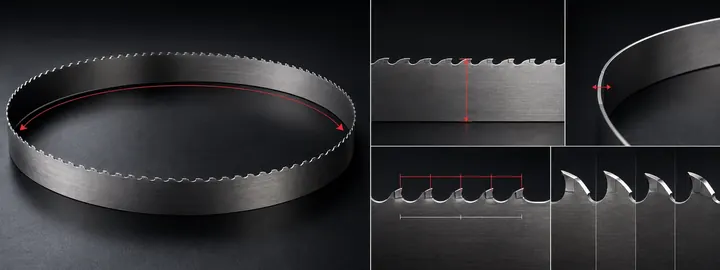
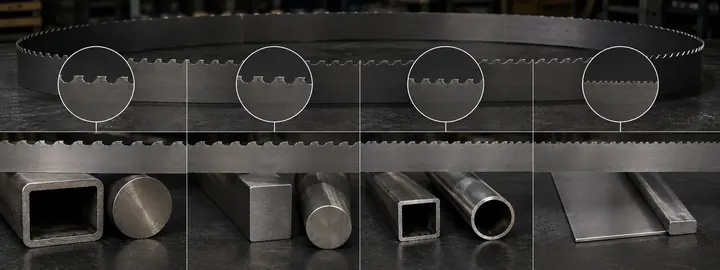
Pitch is the number of teeth the blade has per inch, abbreviated TPI (teeth per inch). A "coarse" pitch has few teeth that are large and widely spaced; a "fine" pitch has many small teeth close together.
The general rule is simple: large teeth (coarse pitch) are for thick, solid material, because they have room to clear a lot of chips and cut fast; fine teeth (fine pitch) are for thin material, tube and profile, because they make a smoother, more controlled cut.
The golden rule: 3 teeth in the material
The most important rule when choosing the pitch is this: at the point of cut there must always be at least 3 teeth touching the material at the same time, and ideally between 6 and 12.
Why? If there are fewer than 3 teeth in the material, each tooth takes too much load, catches on the edges and the blade breaks or loses teeth. If there are too many, the cut becomes slow and the chips do not clear properly. That is why the pitch is matched to the thickness of the part: the thinner it is, the finer the pitch should be.
Constant pitch and variable pitch
There are two ways to arrange the teeth on the blade:
- Constant pitch: all teeth are identical and equally spaced. It gives a very even cut and works well when the material is always the same thickness.
- Variable pitch: the teeth have different sizes and spacings. This reduces vibration and noise and performs very well on varying thicknesses, tube and structural shapes. That is why it is the most widely used today.
Variable pitch is indicated with two numbers, for example "5-8" or "4-6", which are the teeth per inch between which it varies.
Table: which pitch to use by thickness
This table gives you a starting point for choosing the variable pitch according to the thickness or diameter of the part (solid):
| Thickness or diameter | Recommended pitch (variable) |
|---|---|
| Up to 1" (25 mm) | 8-12 or 10-14 TPI |
| 1" a 3" (25 a 75 mm) | 5-8 or 6-10 TPI |
| 3" a 6" (75 a 150 mm) | 4-6 or 3-4 TPI |
| 6" a 12" (150 a 300 mm) | 2-3 or 1.5-2 TPI |
| Over 12" (300 mm) | 1-1.5 or 0.75-1.25 TPI |
These are reference values; the brand, the machine, and the application can change them slightly. We are happy to confirm the ideal pitch for your case.
Tube and structural shapes: use a finer pitch
Tube and structural shapes have thin walls, so on each cut only a few teeth touch the material. To respect the 3-tooth rule, you need to use a finer pitch than you would with a solid bar of the same diameter. In addition, a tension (type T) tooth helps make the cut more stable in hollow sections.
How to choose, in short?
- Thick, solid material: coarse pitch (fewer teeth) cuts fast.
- Thin material, tube and profiles: fine pitch (more teeth) and raker teeth.
- A rule that never fails: at least 3 teeth in contact with the material; if in doubt, go to a slightly finer pitch.
The right pitch depends on the thickness, the shape and even your machine. Tell us what material you cut and the dimensions, and we will tell you the ideal pitch and build the blade to size.
In summary
- Pitch (TPI) is teeth per inch: few, large teeth for thick material, many fine teeth for thin
- Golden rule: always at least 3 teeth touching the material (ideally 6 to 12)
- Variable pitch reduces vibration and adapts to different thicknesses; it is the most widely used
- For tube and structural shapes, use a finer pitch and a tension tooth
Why buy your band saw blades at NAT MAC?
We have more than 54 years of experience in the industry and ISO 9001 certified quality. We help you choose the right pitch and blade type for your material and your machine, and we deliver it welded to size.
- Advice on choosing the right pitch and blade for your material and thickness
- Our own NATCUT line and the Starrett brand
- Bi-metal, carbide and carbon steel
- Blades welded to the length of your machine
- Backed by ISO 9001 certified quality
Tell us what material you cut and in what sizes, and we'll recommend the right pitch and blade. Request your free quote.
Sources: NAT MAC Band saw blades catalog (NATCUT and Starrett); Starrett, Band Saw Blades; Starrett, Band Saw Blades Catalog 60.