 Plastics
What is PEEK and when is it worth it? The highest-performance thermoplastic
PEEK is the plastic you turn to when the others deform, wear out or can't handle the temperature. It is also the most expensive, so it pays to know when it is worth it. In this guide we explain what PEEK is, what properties make it so special and in which applications it justifies the investment.
What is PEEK?
PEEK (polyetheretherketone) is a very high-performance semicrystalline thermoplastic. It offers the highest temperature resistance in its family (continuous service from −60 to 250 °C and 310 °C short-term), unmatched dimensional stability and a combination of stiffness, toughness and wear resistance that lets it replace metal components.
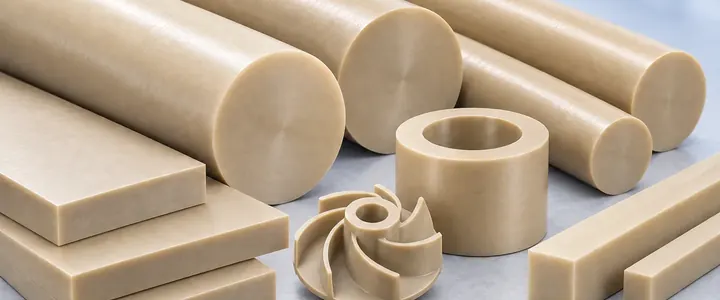
It is self-extinguishing (UL 94 V0), a good electrical insulator, and resists chemicals and abrasion. The grade we carry is natural, unreinforced PEEK, beige in color, in extruded round bars and plates for machining.
Why choose this material?
Compared with metal parts or other plastics, it offers several advantages:
| Advantage | What does it mean? |
|---|---|
| Maximum temperature | Continuous service up to 250 °C and melting at 343 °C; keeps its properties where other plastics fail |
| Stiffness and strength | Yield strength of 110 MPa and modulus of 4,000 MPa; replaces metal parts with less weight |
| Self-extinguishing | UL 94 V0 rating; suitable for applications with flammability requirements |
| Dimensional stability | Water absorption of 0.2% and linear expansion of 50 × 10⁻⁶/K |
| Chemical and wear resistance | Excellent sliding properties, abrasion resistance and tear resistance |
Technical properties
Reference values taken from our data sheet; they may vary depending on manufacturing and application conditions:
| Property | Unit | Value |
|---|---|---|
| Density | g/cm³ | 1.31 |
| Water absorption | % | 0.2 |
| Flammability (3/6 mm) | Class | V0 / V0 |
| Yield strength | MPa | 110 |
| Modulus of elasticity | MPa | 4,000 |
| Shore hardness | D scale | 88 |
| Melting temp. | °C | 343 |
| Deflection temp. (HDT/A) | °C | 152 |
| Service temp. (long-term) | °C | −60 a 250 |
| Service temp. (short-term) | °C | 310 |
| Dielectric strength | kV/mm | 20 |
Available package sizes
| Material | Available forms | Colors | Supply |
|---|---|---|---|
| Polyetheretherketone (PEEK) | Round bars 3/8" – 3" (9.5 mm – 76.2 mm) · Plates 1/4" – 2" (6.35 mm – 50.8 mm) | Natural (beige) | Extruded |
If you need a particular size, tell us which one and we will gladly source it for you.
Where is it used?
Some of the most common applications of this material in industry:
- Electrical insulators and housings
- Cables and cable insulation
- Rotor arms
- Friction discs and gaskets
- Shock absorbers
- Components for analytical equipment
- Components for dialysis equipment
- Valve liners
- Pump impeller wheels
- Parts for high temperatures
- Parts under high mechanical load
- Aerospace components
How to choose?
- Operating temperature above 150 °C: PEEK is one of the few plastics that withstands it in continuous service.
- Replacing a metal part to save weight or avoid corrosion: bushings, gears, seals and precision components in PEEK.
- Aerospace, medical, chemical or analytical equipment industries: PEEK is the usual material in these industries because of its performance.
- If the temperature doesn't exceed 100 °C and cost matters: acetal or PET can cover the application at a lower price.
In summary
- PEEK is the thermoplastic with the highest service temperature in its family: −60 to 250 °C continuous
- It is rigid (110 MPa yield strength), stable, self-extinguishing (UL 94 V0) and resistant to chemicals and wear
- Replaces metal parts in demanding applications: aerospace, medical, chemical and precision
- Worth it when the temperature, load or environment exceeds what acetal, nylon or PET can handle
Why buy your engineering plastics at NAT MAC?
We have more than 54 years of experience in the industry and ISO 9001 certified quality. We carry all ten families of engineering plastics (nylon, polyethylene, acetal, Teflon, polycarbonate, PEEK, PETG, PET, polypropylene and thermosets), each with its own data sheet, and we help you choose the right material for your part, your load and your working environment.
- Material cut to the size you need
- Data sheets with verified properties for each grade
- Advice on choosing the right plastic for your load, temperature and environment
- Stock in bars, plates and bushings with delivery throughout Mexico
- Backed by ISO 9001 certified quality
Tell us what part you'll make, the conditions it operates in and the sizes you need, and we'll recommend the right material. Request your free quote.
Sources: NAT MAC Engineering Plastics data sheets and catalog; TecnoQuim (material data sheets); ISO 527-1, Determination of tensile properties; ISO 868, Shore hardness.