 Plastics
What is polypropylene (PP) and when to use it? Chemical resistance and weldability
For building tanks, ducts, trays and equipment that will be in contact with chemicals, polypropylene is the most practical material: it does not rust, barely absorbs water, weighs very little and welds easily. In this guide we explain what homopolymer polypropylene is, what its properties are and when to use it.
What is polypropylene (PP)?
Polypropylene is a homopolymer thermoplastic (PP-H), partially crystalline and very lightweight: at 0.91 g/cm³ it is the lightest of our engineering plastics. It offers excellent chemical and corrosion resistance, withstands continuous-use temperatures of up to 100 °C (150 °C short-term), absorbs less than 0.1% water and is a good electrical insulator (45 kV/mm dielectric strength).
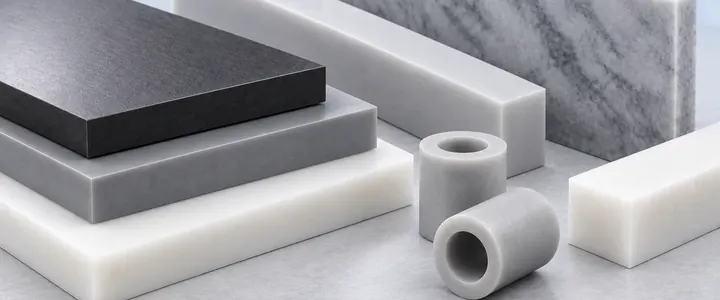
Its big fabrication advantage is weldability: plates are cut, machined, thermoformed and welded with strong joints, making it possible to build custom tanks, ducts and linings. We supply it in extruded plates from 1/8" to 4", in natural, white, light gray, gray, marble gray and black.
Why choose this material?
Compared with metal parts or other plastics, it offers several advantages:
| Advantage | What does it mean? |
|---|---|
| Chemical resistance | Does not rust and resists corrosive substances; ideal for electroplating and chemical processes |
| Very lightweight | 0.91 g/cm³: equipment and tanks that are easy to handle and install |
| Weldable | Strong joints to build custom tanks, ducts and linings |
| Resists heat | Continuous service up to 100 °C and 150 °C short-term |
| Barely absorbs any water | Less than 0.1%; stable in humid environments |
Technical properties
Reference values taken from our data sheet; they may vary depending on manufacturing and application conditions:
| Property | Unit | Value |
|---|---|---|
| Density | g/cm³ | 0.91 |
| Water absorption | % | < 0.1 |
| Yield strength | MPa | 32 |
| Modulus of elasticity | MPa | 1,300 |
| Shore hardness | D scale | 72 |
| Melting temp. | °C | 162–167 |
| Deflection temp. (HDT) | °C | 90 |
| Service temp. (long-term) | °C | 0 a 100 |
| Service temp. (short-term) | °C | 150 |
| Dielectric strength | kV/mm | 45 |
Available package sizes
| Material | Available forms | Colors | Supply |
|---|---|---|---|
| Polypropylene (PP) | Plates 1/8" – 4" (3 mm – 101.6 mm) | Natural, White, Light gray, Gray, Marble gray, Black | Extruded |
If you need a particular size, tell us which one and we will gladly source it for you.
Where is it used?
Some of the most common applications of this material in industry:
- Chemical engineering
- Tank and vessel construction
- Corrosion-resistant vessels
- Electroplating
- Electrolytic tanks and vats
- Ventilation equipment
- Ducts and ventilation systems
- Laboratory technology
- Laboratory equipment
- Chemical covers and guards
- Anti-corrosion components
- Fusion-welded parts
How to choose?
- Tanks, reservoirs and chemical ducting: polypropylene, for its chemical resistance and weldability.
- Electroplating and laboratory equipment: polypropylene plate, cut and welded to size.
- Trays, covers and work surfaces: polypropylene, lightweight and easy to clean.
- If the part needs rigidity or wear resistance: compare it with PE 500 or PE 1000 polyethylene, or with acetal.
In summary
- Polypropylene is the lightest of our engineering plastics (0.91 g/cm³) and resists chemicals and corrosion
- Operates up to 100 °C in continuous service and absorbs almost no water
- Easily cut, machined, thermoformed and welded to build tanks, ducts and linings
- We carry it in plates from 1/8" to 4" in six colors
Why buy your engineering plastics at NAT MAC?
We have more than 54 years of experience in the industry and ISO 9001 certified quality. We carry all ten families of engineering plastics (nylon, polyethylene, acetal, Teflon, polycarbonate, PEEK, PETG, PET, polypropylene and thermosets), each with its own data sheet, and we help you choose the right material for your part, your load and your working environment.
- Material cut to the size you need
- Data sheets with verified properties for each grade
- Advice on choosing the right plastic for your load, temperature and environment
- Stock in bars, plates and bushings with delivery throughout Mexico
- Backed by ISO 9001 certified quality
Tell us what part you'll make, the conditions it operates in and the sizes you need, and we'll recommend the right material. Request your free quote.
Sources: NAT MAC Engineering Plastics data sheets and catalog; TecnoQuim (material data sheets); ISO 527-1, Determination of tensile properties; ISO 868, Shore hardness.