 Plastics
What is Teflon (PTFE) and what is it used for? Non-stick properties and chemical resistance
Teflon is the material you choose when nothing else works: when the part has to resist practically any chemical, work from −260 up to 260 °C or slide with the least possible friction. In this guide we explain what Teflon (PTFE) is, what makes it so special and in which forms we carry it.
What is Teflon (PTFE)?
Teflon, or polytetrafluoroethylene (PTFE), is a high-performance fluoropolymer. It has the lowest coefficient of friction of any solid material (0.06 to 0.09 static and 0.13 dynamic), is completely non-stick and chemically inert, and absorbs no water. It is also an excellent electrical insulator, with a dielectric strength of 59 kV/mm.
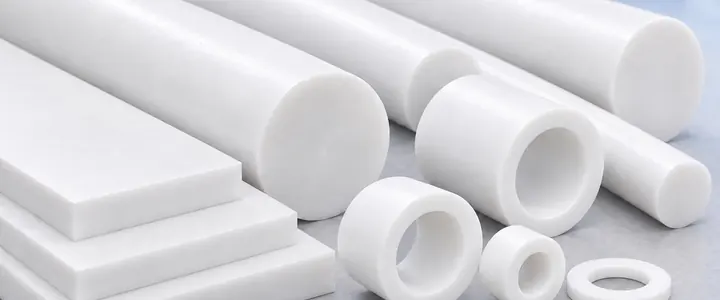
Unlike other plastics, PTFE does not melt in the conventional way: it is processed by compaction and sintering, and is supplied in rods, plates and hollow bars (bushings) for machining. It is natural or white in color, with a density of 2.13 to 2.21 g/cm³.
Why choose this material?
Compared with metal parts or other plastics, it offers several advantages:
| Advantage | What does it mean? |
|---|---|
| Minimum friction | Static coefficient of friction of 0.06 to 0.09: parts slide without lubrication |
| Completely non-stick | Nothing sticks to its surface; ideal for coatings and sliding surfaces |
| Chemically inert | Resists virtually all chemicals; chemical, petroleum, and pharmaceutical industries |
| Exceptional temperature range | Operates from −260 to 260 °C without losing its properties |
| Electrical insulator | Dielectric strength of 59 kV/mm and a dielectric constant of 2.1 |
Technical properties
Reference values taken from our data sheet; they may vary depending on manufacturing and application conditions:
| Property | Unit | Value |
|---|---|---|
| Density | g/cm³ | 2.13 a 2.21 |
| Modulus of elasticity | MPa | 3,100 |
| Shore hardness | D scale | 50 – 55 |
| Static coefficient of friction | — | 0.06 a 0.09 |
| Dynamic coefficient of friction | — | 0.13 |
| Dielectric constant (60 Hz) | — | 2.1 |
| Dielectric strength | kV/mm | 59 |
Available package sizes
| Material | Available forms | Colors | Supply |
|---|---|---|---|
| Teflon (PTFE) | Round bars 3/8" – 15½" (9.5 mm – 394 mm) · Plates 1/64" – 1" (0.4 mm – 25.4 mm) · Hollow bars 1"×½" – 15½"×9⅞" (25.4×12.7 mm – 394×251 mm) | Natural / white | Compacted or sintered |
If you need a particular size, tell us which one and we will gladly source it for you.
Where is it used?
Some of the most common applications of this material in industry:
- Seals, gaskets and packings
- Valve rings and seats
- Non-stick coatings
- Low-friction guides and slides
- Sliding surfaces
- Tank and pipe linings
- Diffusers for corrosive processes
- Electrical insulators
- Electronic components
- Parts for high and low temperature
- Self-lubricating sleeves and bushings
- Bellows and diaphragms
How to choose?
- Seals, gaskets, joints and valve seats: PTFE is the standard thanks to its chemical inertness and non-stick properties.
- Parts that slide without lubrication: guides, skids and self-lubricating PTFE bushings.
- Corrosive or high-temperature processes: linings, diffusers and components for the chemical and pharmaceutical industries.
- If the part carries a high mechanical load: keep in mind that PTFE is soft (50 to 55 Shore D); for high loads, compare it with PEEK or acetal.
In summary
- Teflon (PTFE) has the lowest coefficient of friction of any solid material and is completely non-stick
- It is chemically inert, does not absorb water and works from −260 to 260 °C
- It is an excellent electrical insulator (59 kV/mm)
- We carry it in round bars, plates and hollow bars for machining seals, bushings, valve seats and linings
Why buy your engineering plastics at NAT MAC?
We have more than 54 years of experience in the industry and ISO 9001 certified quality. We carry all ten families of engineering plastics (nylon, polyethylene, acetal, Teflon, polycarbonate, PEEK, PETG, PET, polypropylene and thermosets), each with its own data sheet, and we help you choose the right material for your part, your load and your working environment.
- Material cut to the size you need
- Data sheets with verified properties for each grade
- Advice on choosing the right plastic for your load, temperature and environment
- Stock in bars, plates and bushings with delivery throughout Mexico
- Backed by ISO 9001 certified quality
Tell us what part you'll make, the conditions it operates in and the sizes you need, and we'll recommend the right material. Request your free quote.
Sources: NAT MAC Engineering Plastics data sheets and catalog; TecnoQuim (material data sheets); ISO 527-1, Determination of tensile properties; ISO 868, Shore hardness.