 Metals
What is bronze and which one should you choose? SAE 40, 62, 64, 68 and 660 bronzes
Bronze is the metal of bushings, bearings and gears, and for good reason: it slides against steel without seizing and withstands wear. In this guide we explain what bronze is, why it is the antifriction metal par excellence and which bronzes we carry at NAT MAC, so you can choose the right one for your part.
What is bronze and what is it used for?
Bronze is an alloy of copper with tin and, depending on the grade, also lead or aluminum. Its great quality is that it is an antifriction metal: it slides smoothly against steel, carries loads and resists wear without sticking or scoring the mating part. That is why it is the classic material for bushings, bearings, worm wheels and gears, that is, for parts that turn or slide against each other.
Not all bronzes are the same. Depending on what is added to the mix, a bronze can resist more wear, carry more load, tolerate poor lubrication or machine more easily. That is why there are different SAE grades, each designed for a type of work.
When a steel shaft turns inside a support, it should not rub directly against another steel part, because they heat up, seize, and wear. Bronze goes in between (as a bushing or bearing) because it slides smoothly, dissipates heat, and wears before the shaft does, which is the expensive part. Replacing a bronze bushing is easy and inexpensive; replacing the shaft is not.
The bronzes we carry at NAT MAC
We work with five bronzes, each for a type of job. This table summarizes them:
| Bronze | What is it? | What does it stand out for? |
|---|---|---|
| SAE 40 (C83600) | General-purpose leaded red brass | Valves, fittings and castings |
| SAE 62 (C90500) | Tin bronze | Wear resistance and high-load capacity |
| SAE 64 (C93700) | Anti-friction lead-tin bronze | High speed and little lubrication |
| SAE 68 (C95400) | Aluminum bronze | The highest strength and impact resistance |
| SAE 660 (C93200) | General-purpose lead-tin bronze | All-purpose bearings and bushings |
Below we explain each one: what it is and what it is used for.
SAE 40 Bronze (C83600): general use for valves and fittings
SAE 40 bronze is a general-purpose leaded red brass. It is easy to machine and cast and resists corrosion well, which is why it is widely used in low-pressure valves, fittings and castings.
Typical applications: low-pressure valves, threaded fittings and connections, pump bodies and impellers, hydraulic fittings, light bushings, and industrial and marine hardware.
SAE 62 Bronze (C90500): wear and load resistance
SAE 62 bronze is a tin bronze with excellent wear resistance and good load capacity. It is ideal for bushings, bearings, worm wheels and gears that work under friction and high loads.
Typical applications: bushings and sleeves, sliding bearings, worm gear rims and gears, nuts for ACME screws, wear plates and guides, and thrust washers.
SAE 64 Bronze (C93700): anti-friction for high speed
SAE 64 bronze is a lead-tin antifriction bronze designed for high speed. It tolerates scarce lubrication and reduces seizing, so it works well in bearings and bushings that turn fast.
Typical applications: high-speed bearings, bushings and sleeves, bearings under marginal lubrication, bearings for electric motors and sliding guides for rolling mills.
SAE 68 Bronze (C95400): the highest strength (aluminum bronze)
SAE 68 bronze is an aluminum bronze with very high mechanical and impact strength and excellent corrosion behavior. It is the one for gears, worm wheels and parts that support high loads.
Typical applications: heavy-duty gears, worm gear wheels, valve seats and guides, heavy-duty bushings and bearings, and components for marine machinery.
SAE 660 Bronze (C93200): the all-around bearing bronze
SAE 660 bronze is a lead-tin bronze for general-purpose bearings and bushings. It machines very well and delivers good antifriction performance at moderate loads and speeds. It is the all-purpose bearing bronze, the one that solves most cases.
Typical applications: bushings and sleeves, sliding bearings, bushings for pumps and motors, light-duty gears and pinions, and bearings for machine tools.
Forms and sizes we carry
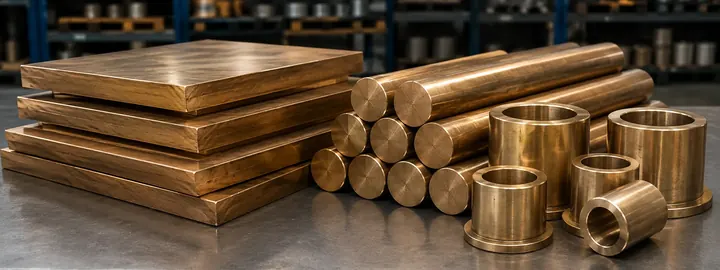
All five bronzes come in the same two forms, round bar and hollow bar, in these sizes:
| Bronze | Round bar | Hollow bar |
|---|---|---|
| SAE 40 | 1/2" a 4" | 1-1/2" × 3/4" a 4" × 2" |
| SAE 62 | 1/2" a 4" | 1-1/2" × 3/4" a 4" × 2" |
| SAE 64 | 1/2" a 4" | 1-1/2" × 3/4" a 4" × 2" |
| SAE 68 | 1/2" a 4" | 1-1/2" × 3/4" a 4" × 2" |
| SAE 660 | 1/2" a 4" | 1-1/2" × 3/4" a 4" × 2" |
Hollow bar already comes with a hole through the center, so it is perfect for making bushings and sleeves: you save material and avoid drilling the part from scratch. The size is given as outside diameter by inside diameter (for example, 4" × 2").
How to choose the right bronze?
The simplest way to choose is to think about how the part will work: the load, the speed and the lubrication it will have.
- If you need resistance to wear and high loads in bushings, worm wheels or gears, SAE 62 is your bronze.
- If your bearing spins fast or runs with little lubrication, choose SAE 64.
- If you need maximum strength and impact resistance (high-load gears), go for SAE 68 (aluminum bronze).
- If you want a general-purpose bearing or bushing that is easy to machine, SAE 660 solves most cases.
- If you are making valves, fittings or cast parts, the right choice is SAE 40.
In summary
- Bronze is the antifriction metal par excellence: it slides against steel without seizing
- It is the classic material for bushings, bearings, ring gears and gears
- Each SAE grade varies with the load, speed and lubrication of the part
- All are supplied in round bar and hollow bar (ideal for bushings)
Why buy your bronze at NAT MAC?
We have been supplying metals to industry for more than 54 years and work with ISO 9001 certified quality. We help you choose the right bronze based on how your part will work and deliver it cut to size.
- SAE 40, 62, 64, 68 and 660 anti-friction bronzes
- Round bar and hollow bar (ideal for making bushings)
- Advice on choosing the right bronze for your load, speed and lubrication
- Cut to size
- Backed by ISO 9001 certified quality
Tell us what part you will make and how it will work, and we'll give you pricing and availability right away. Request your free quote.
Sources: NAT MAC Metals data sheets and catalog; Copper Development Association, UNS Standard Designations for Copper and Copper Alloys; Copper Development Association, alloy database (alloys.copper.org).