 Metals
How hard are metals? Hardness of aluminum, copper, bronze and brass
Aluminum, copper, bronze and brass are softer metals than steel, but there are important differences in hardness among them that are worth knowing when choosing the material. In this guide we explain what hardness is, what scales it is measured on in these metals and how hard each grade we carry at NAT MAC is.
What is hardness and why does it matter?
Hardness is a metal's resistance to being scratched, penetrated or worn. In practice it indicates how well a part withstands rubbing and use without being marked or worn down. The higher the hardness, the greater the wear resistance, although there is usually less ability to deform without breaking. If you want to go deeper on the subject, we explain it in detail in our article on steel hardness.
In aluminum, copper, bronze and brass, hardness is especially relevant because they are relatively soft metals: choosing the grade with the right hardness keeps a part from wearing out early or, conversely, from being too brittle for its function.
Which scale is used to measure hardness in these metals?
Since these metals are softer than steel, they are not measured on the Rockwell C scale (HRC), which is reserved for very hard materials such as hardened steels. Instead, the Brinell (HB) and Rockwell B (HRB) scales are mostly used:
| Scale | Symbol | What is it used for here? |
|---|---|---|
| Brinell | HB | The most common for these metals, from soft to medium hardness |
| Rockwell B | HRB | Low and medium hardness metals (brass, bronze, treated aluminum) |
| Rockwell C | HRC | Only for the very hard grades; among these metals, only beryllium copper |
The same metal can have very different hardnesses depending on how it was processed. In aluminum, a T6 temper (heat treated) is much harder than H14 (strain hardened). In copper, H02 and H04 tempers harden the material by cold working. That is why hardness values are always given as approximations.
How hard is each metal: comparison table
This table ranks the grades we carry, from softest to hardest, with their approximate typical hardness. These are reference values: actual hardness depends on the hardening and treatment of each piece.
| Metal and grade | Typical hardness (approx.) | Comment |
|---|---|---|
| 3003 Aluminum | ~ 40 HB | The softest; designed for forming and bending |
| C11000 copper (electrolytic) | 45 a 100 HB | Soft; work hardens with cold working (H02 and H04 tempers) |
| C26000 brass (sheet) | 60 a 75 HB | Varies with the temper |
| Bearing bronzes (SAE 40, 64 and 660) | 60 a 75 HB | General-purpose anti-friction bronzes |
| SAE 62 Bronze | 75 a 85 HB | Greater wear resistance |
| 6061-T6 aluminum | ~ 95 HB | Hardened with heat treatment |
| C36000 Brass | 100 a 120 HB | Balance between machinability and hardness |
| Chromium coppers (C18150 and C18200) | 110 a 150 HB | Hardened by heat treatment |
| 7075-T6 aluminum | ~ 150 HB | The hardest aluminum |
| SAE 68 Bronze (aluminum bronze) | ~ 170 HB | The hardest bronze |
| C17200 beryllium copper | 36 a 41 HRC | The hardest of all; comparable to a tool steel |
Two of these materials reach unusually high hardness. C17200 beryllium copper reaches 36 to 41 HRC, a hardness typical of a tool steel, which is exceptional for a copper. And SAE 68 aluminum bronze is by far the hardest and strongest bronze, which is why it is used in gears and high-load parts.
How is hardness measured?
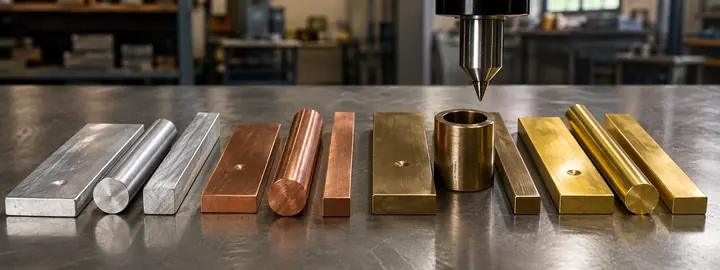
Hardness is measured with a device called a hardness tester, which presses a point against the metal with a known force and gives the value directly on the corresponding scale. It is a quick test, widely used in quality control to confirm that a part has the correct hardness. At NAT MAC we carry measuring equipment, including hardness testers, to verify your parts.
In summary
- Aluminum, copper, bronze and brass are softer than steel, but they vary a lot among themselves
- They are mostly measured on the Brinell (HB) and Rockwell B (HRB) scales, not Rockwell C
- Hardness depends on the hardening and treatment of each grade
- Beryllium copper and aluminum bronze are the hardest; 3003 aluminum and pure copper are the softest
Why buy your metals at NAT MAC?
We have supplied metals to industry for more than 54 years and operate with ISO 9001 certified quality. We advise you on selecting the metal and grade with the right hardness for your part and, when you need it, we have measuring equipment to verify it.
- Aluminum, copper, bronze and brass in various grades and forms
- Advice on choosing the metal with the right hardness for your application
- Measuring equipment, including hardness testers
- Cut to size
- Backed by ISO 9001 certified quality
Tell us what part you are going to make and how it will work, and we will help you choose the right metal and hardness. Request your free quote.
Sources: NAT MAC Metals data sheets and catalog; ASTM E18, Rockwell Hardness of Metallic Materials; ASTM E10, Brinell Hardness of Metallic Materials; Copper Development Association, alloy database (alloys.copper.org); The Aluminum Association, International Alloy Designations and Chemical Composition Limits (Teal Sheets).