 Measurement
What hand measuring tools are there and what is each one for?
Hand measuring tools are the foundation of quality control in any workshop: with them you verify that each part comes out at the right size. In this guide we explain what they are, what each one is for and how to choose the right one. All of our tools are from the Starrett brand.
What are hand measuring tools?
These are instruments used by hand, directly on the part, to measure and verify its dimensions, angles, hardness or finish. They are the everyday tools in the shop and the quality lab, from a simple vernier caliper to a surface roughness tester.
The hand tools we carry
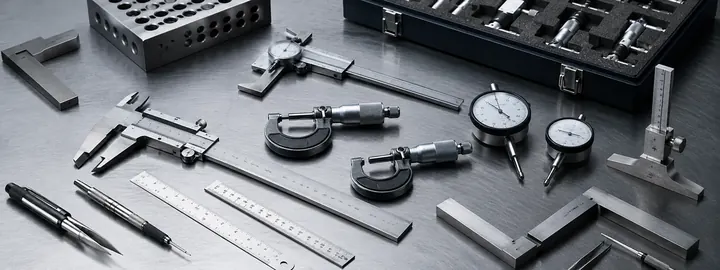
We carry the full line of Starrett hand measuring tools. This table summarizes them, under the same name you will find on our website, and what each one is for:
| Tool | What is it for? |
|---|---|
| Calipers | Measure outside, inside, and depth; the most widely used instrument in the shop |
| Micrometers | They measure more precisely than the caliper, for outside, inside and depth measurements |
| Inside and depth gages | Instruments specifically for measuring holes, slots and depths |
| Indicators and dial gages | They measure a part's deviations from a reference (flatness, concentricity, runout) |
| Bore gages | They precisely measure the inside diameter of bores |
| Squares | They check the squareness, that is, the 90°, of parts |
| Rules and parallels | They serve as a reference for straightness and parallelism |
| Protractors and angle gages | They measure angles |
| Dividers and layout tools | They mark and scribe lines and centers on the part |
| Height gages | They measure and scribe heights with precision |
| Hardness testers | They measure the hardness of the material |
| Thickness and coating gages | They measure wall thickness and the thickness of layers or coatings |
| Surface roughness testers | They measure surface finish, that is, roughness |
| M1® Lubricant | Protects and preserves instruments and parts against corrosion |
Caliper or micrometer: which one should you use?
This is the most common question in the shop. The caliper is versatile and fast: it measures outside, inside and depth, and it is the go-to instrument for everyday work. The micrometer measures more precisely, but each one covers a smaller measuring range. In short: use the caliper to measure quickly and for everything, and the micrometer when you need maximum accuracy on a single dimension.
How to choose the right tool?
The choice depends on what you want to measure:
- Dimensions (length, diameter, depth): caliper or micrometer.
- Bore inside diameter: bore gage.
- Angles: goniometer or protractor.
- Squareness and straightness: squares, straightedges and parallels.
- Material hardness: hardness tester.
- Surface finish: surface roughness tester.
In summary
- Hand tools are the foundation of quality control in the workshop
- They cover dimensions, angles, squareness, hardness and finish
- The caliper is the most versatile; the micrometer gives greater precision
- We carry the full line of Starrett hand tools
Why buy your measuring equipment at NAT MAC?
We are a Starrett distributor, one of the most prestigious brands in the world of metrology, with more than 54 years of experience in the industry and ISO 9001 certified quality. We advise you on choosing the right equipment for what you need to measure.
- Starrett measuring equipment for dimensional and quality control
- Advice on choosing the right instrument for your part and process
- Hand tools, vision systems, optical comparators, laser measurement, granite and force testing
- Backed by ISO 9001 certified quality
Tell us what you need to measure and with what accuracy, and we'll recommend the right equipment. Request your free quote.
Sources: NAT MAC Measurement catalog; Starrett (metrology catalogs).