 Steel
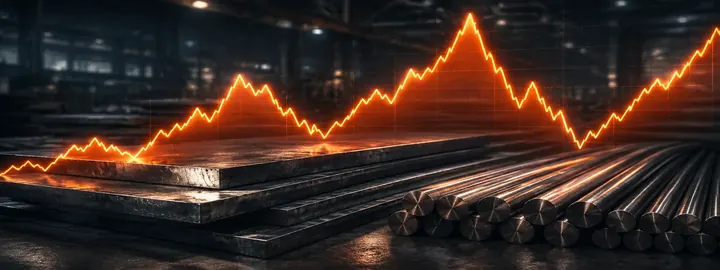
SteelWhy does the price of steel change so much? 20 years of ups and downs
Steel does not have a fixed price. Over the last 20 years it has gone up and down sharply, sometimes within a matter of months. Here we tell you, simply and with data, how the price of steel has moved worldwide, which moments marked it and what makes it rise or fall.
Why isn't the price of steel fixed?
Steel is a raw material that is bought and sold all over the world, just like oil or copper. Its price is not set by a single country or a single company: it is driven by supply and demand across the whole planet. When there is a lot of construction and many factories running, steel is in greater demand and goes up. When the economy slows and there is surplus steel, it goes down.
It also costs what it takes to make it. Making steel takes iron ore, coal, and a lot of energy; if those go up, steel goes up. And there is one player that runs this story: China, which makes more than half of the world's steel. When China has surplus steel and sells it cheap, it drags everyone's price down.
In the following chart you can see how much the price has changed at the most important moments of these years:
The moments that shaped the price
In the chart above it is plain to see: the price of steel is a roller coaster. Each bar is an important moment, and every rise or fall has its explanation. The data comes from SteelBenchmarker, a firm that tracks steel prices worldwide. Here is a review of the last 20 years:
2004 to 2008: the great boom
During these years the world went through a commodities boom, driven by China's rapid growth, which kept buying steel and iron ore nonstop. The price rose year after year until it hit its peak in mid-2008: world export steel reached about $1,113 per ton.
2008 to 2009: the financial crisis
The global financial crisis hit and everything came to a sudden halt. Construction and industry stopped, nobody was buying steel, and prices collapsed. In less than a year the price fell by more than half. It was one of the fastest drops ever seen.
2010 to 2011: the rebound
With government plans to restart the economy, demand gradually returned and the price partly recovered, reaching around $773 per ton in early 2011. It did not return to boom-era levels, but it stabilized.
2012 to 2016: the long decline
Here comes a difficult stage. China had built so many steel mills that it began producing far more steel than it consumed, and that surplus was sold to the world at low prices. With so much cheap steel around, the price kept falling for years. In February 2016 it hit bottom: just 272 dollars per ton, the lowest level in a long time.
2017 to 2019: the recovery and tariffs
Prices gradually recovered. In this period, the United States imposed tariffs on steel imports (the famous Section 232, in 2018) to protect its producers. That made imported steel more expensive and pushed prices upward, especially in the U.S. market.
2020 to 2021: the pandemic and the all-time record
At the start of the pandemic, in 2020, the price fell quickly because of the scare and the shutdowns. But then something unexpected happened: it shot up like never before. Factories had cut production, inventories were empty and suddenly everyone wanted to buy steel at the same time. On top of that came expensive iron ore, sky-high freight and congested ports.
The result was a record rise. In the United States steel reached an all-time high of $2,143 per ton in October 2021, something never seen before.
2022: the war in Ukraine
In 2022, the war between Russia and Ukraine (two major steel producers and exporters) shook the market again. The world export price jumped to about $1,275 per ton in April 2022. But afterward, with fear of a recession, expensive energy and a weaker China, the price began to fall again.
2023 to 2026: diverging paths
In recent years the worldwide price has been trending down, pressured by excess Chinese steel and weak demand. As of August 2026, world export steel is near 505 dollars per ton, far from the 2022 peak. In the United States, however, the price remains high (around 1,284 dollars per ton), supported by tariffs that hold back imported steel. It shows how the same material can be worth very different amounts depending on the country and its rules.
The key numbers
This table brings together the most important moments of the last 20 years, in dollars per ton. Two references are shown: world export steel and the United States market.
| Moment | World export | United States |
|---|---|---|
| Pre-crisis peak (2008) | ~ $1,113 | ~ $1,203 |
| Post-crisis low (2009) | ~ $496 | ~ $429 |
| Multi-year low (2015-2016) | ~ $272 | ~ $412 |
| Recovery with tariffs (2018) | rising | ~ $1,006 |
| All-time record (Oct 2021) | rising | ~ $2,143 |
| Peak from the war (Apr 2022) | ~ $1,275 | high |
| Current level (Aug 2026) | ~ $505 | ~ $1,284 |
These are reference values (hot-rolled band, HRB) to give an idea of the magnitude of the changes. Source: SteelBenchmarker.
What makes the price go up or down?
If we had to sum up what drives the price of steel, it would be these factors:
- The global economy: when construction and industry are strong, prices rise; when they slow down, prices fall.
- China: produces more than half of the world's steel. When it has a surplus, it floods the market and drives prices down.
- Raw materials: iron ore, coal and energy. When they go up, steel goes up.
- Tariffs and each country's rules: they can make imported steel more expensive and keep local prices up.
- Freight and logistics: when moving steel becomes expensive or slow, the price takes a hit.
- The dollar: because steel is priced in dollars, the exchange rate affects how much you pay in pesos.
Because steel prices swing so much, it pays to plan your purchases and not leave everything to the last minute. Having a supplier with inventory and good lead times helps you avoid stopping production when the market gets tough.
In summary
- The price of steel is not fixed: it rises and falls with worldwide supply and demand
- In 20 years it has lived through the 2008 boom, the crisis, the drop caused by Chinese oversupply and the 2021 record
- It is driven by the economy, China, raw materials, tariffs and the dollar
- The same steel can be worth very different amounts depending on the country and its rules
Why buy your steel at NAT MAC?
We have been in the steel market for more than 54 years, so we know its ups and downs well. We work with ISO 9001 certified quality and help you plan your purchases so that price swings do not hold up your production.
- Carbon, alloy, tool and stainless steels
- Inventory and lead times so you never have to stop production
- Advice on choosing the steel and buying what you really need
- Cut to size
- Backed by ISO 9001 certified quality
Tell us which steel you need and when, and we'll give you pricing and availability right away. Request your free quote.
Sources and references
All the information in this article came from these pages. You can click on them to check them:
- SteelBenchmarker (steel price history). The per-ton figures and the peaks and dips in the chart come from here. steelbenchmarker.com/history.pdf
- MEPS International (how steel reached record highs during the pandemic). It explains the 2020 and 2021 surge. mepsinternational.com
- CRU Group (analysis of the record price cycle). It details the causes of the historic rise. crugroup.com
- Fastmarkets (steel prices in times of crisis). It covered the 2008 and 2009 crisis. fastmarkets.com
- FocusEconomics (steel price in the United States). The effect of tariffs and the current U.S. price come from here. focus-economics.com