 Steel
SteelWhat heat treatments exist for steel and what is each one for?
The same steel can end up soft and easy to work, or hard and strong. What turns one into the other is heat treatment. Here we explain, in simple words, what a heat treatment is, which ones are most common and which one suits each steel best.
What is a heat treatment?
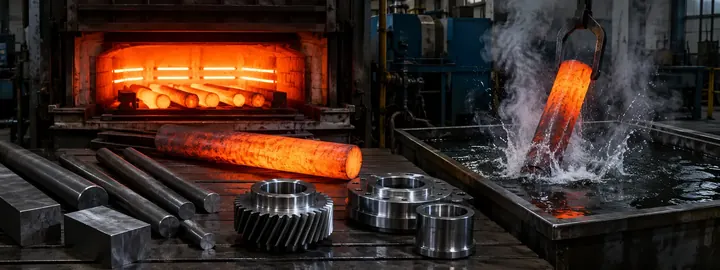
A heat treatment is heating steel to a certain temperature and then cooling it in a controlled way. This changes its properties: how hard it ends up, how well it withstands a blow and how easy it is to machine. It is how steel is made ready for the job it will do.
The most important thing is how the steel is cooled. If it cools quickly, it ends up harder. If it cools slowly, it ends up softer. That one detail means the same steel can end up very different.
No treatment is "better" than another. Some soften the steel so it can be worked and others harden it so it can withstand use. Which one suits you depends on what the part is for.
The most common treatments
These are the ones you will hear about the most. The table tells you what each one does to steel and what it is used for:
| Treatment | What does it do to the steel? | When is it used? |
|---|---|---|
| Annealed | Softens it by cooling very slowly | When you want to machine or work it easily |
| Normalizing | Makes it even and uniform inside | So it is stable before machining |
| Quenching | Hardens it by cooling it suddenly | When the part will suffer wear or needs a cutting edge |
| Tempering | Takes away the brittleness (comes after hardening) | Always after quenching, so it does not crack |
| Quenched and tempered | Quenching and tempering together | When the part needs strength and toughness at the same time |
| Carburizing | Hardens only the outer layer | For parts hard on the outside and tough on the inside |
| Nitriding | Hardens the surface without distorting the part | When the part is already at its final size |
Quenching and tempering: they almost always go together
Quenching is the main hardening treatment. The steel is heated and cooled suddenly, and that leaves it very hard. The problem is that freshly quenched steel is also brittle: it resists wear, but it can crack from a single blow.
That is why it is almost never left as-quenched. It gets a second step called tempering: it is heated again, but to a lower temperature, to take away the brittleness. It loses a little hardness this way, but gains a lot of toughness. When a steel goes through both steps, quenching and then tempering, it is said to be quenched and tempered. That is how 4140, 4340 and 9840 come from the mill.
In hardening, what the steel is cooled in also matters: air, oil or water. Each grade calls for its own. For example, D2 and S7 are air-hardened, and O1 is oil-hardened. If it is done wrong, the part can crack.
Surface hardening only: carburizing and nitriding
Sometimes you don't want the whole part to be hard, because a steel that is hard all the way through becomes brittle. For many parts the ideal is to be hard on the outside, to withstand wear, but tough on the inside, to withstand shock. That is exactly what these two treatments do:
- Carburizing: used on low-carbon steels such as 1018 and 8620. Carbon is introduced into the part's surface with heat and then it is quenched. It ends up with a very hard outer layer and a soft core that absorbs shock. It is the typical choice for gears and parts that rotate or roll.
- Nitriding: also hardens the surface, but at a lower temperature, so the part barely distorts. That is why it is used on parts that are already finished to size, such as molds.
What treatment does each steel get?
Not all steels are treated the same. Each grade responds best to a certain treatment. These are the ones we carry most:
| Steel | Best-suited treatment | For what type of part? |
|---|---|---|
| 1018 | Carburizing | Parts hard on the outside and soft on the inside |
| 1045 | Quenching | Machine parts that need more hardness |
| 8620 | Carburizing | Gears and parts that suffer wear |
| 4140 | Quenched and tempered (quench and temper) | Shafts and axles that carry load |
| 4340 | Quenched and tempered (quench and temper) | Highly stressed parts |
| 9840 | Quenched and tempered (quench and temper) | Demanding machine parts |
| P20 | Comes pre-hardened | Molds, ready to machine without further steps |
| H13 | Quenching and tempering | Tools that work hot |
| S7 | Air hardening | Tools that take heavy impact |
| O1 | Oil quenching | Cold cutting tools |
| D2 / A2 | Air hardening | Long-life stamping and drawing dies |
| 420 | Quenching | Stainless parts that need an edge or hardness |
We deliver several steels already treated at the mill, so you skip that step. P20 comes pre-hardened, ready to machine, and grades such as 4140 and 4340 come quenched and tempered.
How to choose? Think about how the part will work
The easiest way to choose is to first think about what the part will be used for. That tells you which treatment you need:
- Will you only machine it, and it won't see much stress? A soft steel, in its normal or annealed condition, will do.
- Will it carry a load without breaking, like a shaft or an axle? Go for a quenched and tempered steel, such as 4140 or 4340.
- Will it see heavy wear or need a sharp edge, like a blade or a die? You need a hard, hardened steel, such as D2 or O1.
- Do you want it hard on the outside but able to withstand shock on the inside, like a gear? A case-hardened steel, such as 8620, is for you.
Where are heat treatments done?
Heat treatments are done by a specialized shop, with temperature-controlled furnaces. We do not perform the treatment, but we do supply the right steel for your job, and several grades come already treated from the factory (quenched and tempered or pre-hardened). If you don't know which to order, we will advise you.
In summary
- A heat treatment changes steel by heating and cooling it in a certain way
- Quenching hardens and tempering removes the brittleness; together they are called quenched and tempered
- Carburizing leaves the part hard on the outside and soft on the inside
- Each steel needs its own heat treatment and its own cooling method
Why buy your steel at NAT MAC?
We have been supplying steel to industry for more than 54 years and work with ISO 9001 certified quality. We help you choose the right grade based on how your part will work, and we deliver many grades already factory-treated.
- Carbon, alloy, tool and stainless steels
- Quenched and tempered and pre-hardened grades ready to work
- Advice on choosing the right steel and treatment
- Cut to size
- Backed by ISO 9001 certified quality
Tell us what part you will make and how it will work, and we'll help you choose the right steel. Request your free quote.
Sources: NAT MAC Steel data sheets and catalog; ASM Handbook Vol. 4A, Steel Heat Treating Fundamentals and Processes.