 Steel
SteelWhich carbon steel should you choose? Structural bars and plates
Carbon steel is the most widely used of all: it is used every day to make parts and put up structures. It is economical and suits almost everything, but it is not just one steel. In this guide we explain, in plain terms, the two main groups (bars and plates), which steel suits each job and the sizes we stock.
What is a carbon steel?
It is the simplest and most common steel: basically iron with a little carbon. Because it does not contain many expensive ingredients, it is economical, easy to find, and the basis of almost everything made and built in metal.
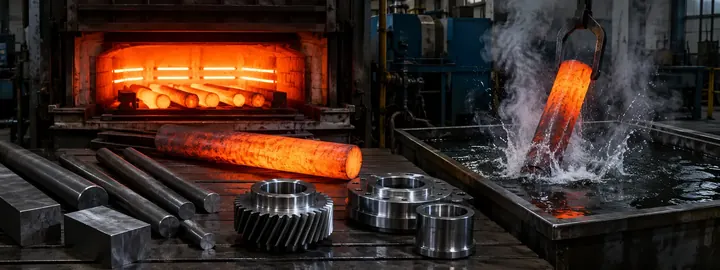
What changes how it behaves is the amount of carbon it contains. With little carbon it stays soft: it welds and machines without a fight (as with 1018). With more carbon it becomes stronger and can even be hardened by quenching, which is a special heating and cooling that leaves it harder (as with 1045).
One important detail: these steels are not stainless. If the part will be outdoors or exposed to moisture, paint or oil it so it does not rust.
Two main groups: bars and plates
To choose well, first look at what you are going to do:
- Carbon bars: these are for making parts such as shafts, axles, bushings and fasteners. This is where 1018, 1045, 12L14 and chrome bar come in.
- Structural plates: these are for building: structures, bases, tanks and vessels. This group includes A36 and the high-strength and pressure vessel plates (A283, A285, A516, A572 and A709).
Are you making a part? Think bar (1018, 1045, 12L14 or chrome-plated). Are you building a structure or a tank? Think plate (A36 and the high-strength ones).
What forms does steel come in?
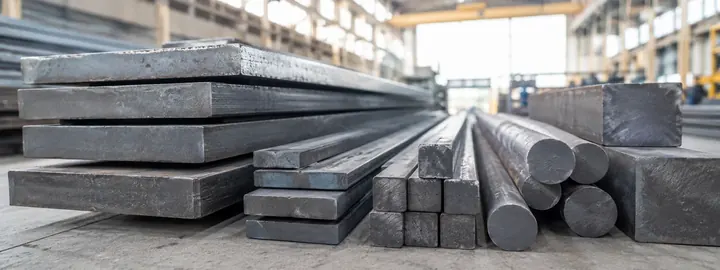
Carbon steel does not come in just one format. These are the forms we carry; the tables show which forms and sizes each grade comes in. Sizes are in inches: for bars it is the diameter (or the side), and for plate it is the thickness.
- Round bar: the cylindrical one. It is the most widely used for shafts, axles and lathe-turned parts.
- Square bar: square in cross section. For bases, metalwork and structural parts.
- Hex bar: six-sided. Ideal for fasteners, nuts and connections (measured “across flats,” from one flat side to the opposite one).
- Flat bar: a long, flat bar, like a thick ruler. For metalwork, reinforcements and bases.
- Plate: thick steel sheet. For structures, tanks and vessels.
Carbon steel bars: 1018, 1045, 12L14 and chrome-plated
| Grade | What it is | Ideal for | Package sizes and dimensions |
|---|---|---|---|
| 1018 | Low carbon, soft and easy to weld | Fasteners, shafts and general-purpose parts | Round: 1/8" to 6 1/2" Square: 1/8" to 4" Hex: 3/8" to 2" Flat bar: 1/8"×1/2" to 3"×8" |
| 1045 | Medium carbon: stronger and hardenable | Shafts, gears and axles | Plate: 1/4" to 10" |
| 12L14 | Contains lead, very easy to machine | Fasteners and batch-machined parts | Round: 1/4" to 3 3/4" Hex: 5/16" to 3" |
| 1045 chrome-plated | Chrome-plated bar, smooth and hard | Hydraulic cylinder rods | Chrome-plated round: 3/8" to 6" 6 m lengths (cut to size) |
1018: the general-purpose grade
1018 is a low-carbon steel, meaning it has little carbon. It is soft, welds without problems and machines easily, so it is the one used for almost everything: fasteners, light shafts, bushings and general-purpose parts. It can also be carburized (hardened only on the outside) when a harder surface is needed.
1045: when more strength is needed
1045 has more carbon, so it is stronger than 1018 and can be hardened by quenching. It is the steel for shafts, gears and axles that carry more load. We stock it in plate from 1/4" to 10".
12L14: the free-machining grade
12L14 contains a little lead, which makes it super easy to machine: it cuts fast and with a good finish. It is the ideal steel for fasteners and parts made in volume on the lathe. It is not for welding or for jobs that demand high strength.
1045 chrome-plated: for hydraulic cylinders
It is a 1045 bar with a layer of hard chrome on the outside: it comes out smooth, bright and wear resistant. It is the go-to bar for the rods (the bars that move in and out) of hydraulic cylinders. We carry it from 3/8" to 6" in diameter, in 6-meter lengths and cut to size.
Structural plates: A36 and high-strength grades
When the job is building rather than making a part, plates come into play. The most common is A36, but there are grades with more strength and others made for pressure vessels (tanks and boilers that hold pressure inside):
| Grade | What it is for | Plate thickness |
|---|---|---|
| A36 | General-purpose structures | 3/16" a 6" |
| A283 | Structural plate | 3/16" a 4" |
| A285 | Pressure vessels | 3/16" a 2" |
| A516 | Pressure vessels (boilers, tanks) | 3/16" a 4" |
| A572 | High-strength structure | 3/16" a 4" |
| A709 | Bridge structures (high strength) | 3/16" a 4" |
A36 is the bread and butter of structural work. When you need the same structure but lighter and stronger, A572 is used (or A709 for bridges). And for tanks, boilers and vessels that work under pressure, certified plates such as A285 and A516 are ordered. We cut them all to size, also in flat bar.
How to choose the right carbon steel
First decide something simple: are you going to make a part or build something? If it is a part, you need bar. If you are building a structure or a tank, you need plate. From there, choose based on what you are looking for:
If you are making a part (bar):
- For general use or anything you'll weld: 1018.
- If you need more strength or the ability to harden it: 1045.
- For parts produced in series on the lathe: 12L14.
- For a hydraulic cylinder rod: chrome-plated 1045.
If you are building (plate):
- General structural use: A36.
- For a lighter, stronger structure, or for bridges: A572 (or A709 for bridges).
- Tanks, boilers or pressure vessels: A285 or A516.
Finally, tell us the size (diameter or thickness), the shape you need and whether you want it cut to size.
Before ordering your carbon steel from us, have on hand
- If you are making a part (bar) or building (plate)
- If the part will be welded, machined or hardened
- If it is for structures, high strength or pressure vessels
- Sizes (diameter or thickness) and whether you want it cut to size
Why buy your carbon steel at NAT MAC?
We have been supplying steel to industry for more than 54 years and work with ISO 9001 certified quality. We stock bars and plates, and we help you choose the right grade for your part or your structure.
- Bars (1018, 1045, 12L14 and chrome-plated) in various shapes: round, square, hex and flat bar
- Structural and pressure vessel plate (A36, A283, A285, A516, A572 and A709)
- Cut to size
- Advice on choosing the right bar or plate
- Backed by ISO 9001 certified quality
Tell us what you plan to make or build, and we'll help you choose the right carbon steel, with the size and cut you need. Request your free quote.
Sources: NAT MAC Steel data sheets and catalog; ASTM International (ASTM standards); Total Materia, Introducción al sistema de designación SAE-AISI.