 Steel
SteelWhat are machinery grade steels and how do you choose the right one?
When you are going to make a shaft, a gear or a crankshaft, the steel you start with decides how long the part will last. That is where machinery grade steels come in. In this guide we explain in plain words what they are, how they differ and how to choose the right one for what you need to do.
What is a machinery grade steel?
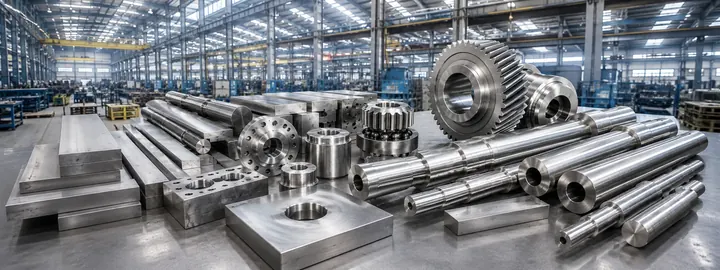
These are the steels used to make machine parts: shafts, axles, gears, crankshafts, pinions and fasteners. Their big advantage is that they combine two things that normally work against each other: they carry heavy loads without deforming (strength) and, at the same time, do not break suddenly (toughness).
They are called “alloy” steels because, besides iron and carbon, they contain other elements such as chromium, nickel and molybdenum. Those ingredients are what make the steel harden evenly and hold up better. They differ from tool grade steels (used for cutting and shaping) and from carbon steels (more economical, for structures). That is why they are the backbone of the automotive industry, metalworking and machinery manufacturing.
Quenched and tempered or carburized: the difference that matters most
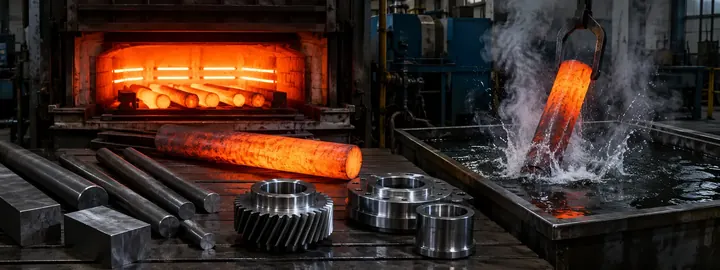
Almost all of these steels get their hardness one of two ways. Knowing which one you need is half the decision:
- Quenched and tempered: the steel hardens evenly throughout the part, inside and out. It ends up strong without becoming brittle. It is what you need when the whole part works under stress. Grades: 4140, 4340 and 9840.
- Carburizing: only the outer layer hardens and the core stays softer. Think of it as a part with a hard “shell” and a flexible heart: the surface withstands wear and the core absorbs shock. It is ideal for gears. Grade: 8620.
If the whole part is under stress, choose a quenched and tempered steel (4140, 4340 or 9840). If only the surface wears and the core takes impacts, as in a gear, choose a carburizing grade (8620).
The grades we carry and what each one is for
| Grade | In a nutshell | Ideal for | How we supply it |
|---|---|---|---|
| 4140 | The most widely used and versatile | Shafts, gears, fasteners, crankshafts | Round bar from 1/4" to 10" · plate from 1/8" to 10" |
| 4340 | The strongest (contains nickel) | Highly stressed, large parts | Round bar from 1/2" to 22" · pre-machined forged |
| 8620 | Hardens only on the outside | Gears and parts subject to wear | Round bar from 1 5/8" to 12" · plate from 1/4" to 10" |
| 9840 | High strength and very reliable | Shafts, gears and demanding crankshafts | Round bar from 1" to 12" · plate from 1/4" to 10" |
4140: the most widely used
It is the most requested machinery-grade steel, and for good reason: it gives good strength without being expensive and machines easily. It is often available already treated (quenched and tempered), so it arrives ready to work. It is good for almost everything: shafts, gears, high-strength fasteners and medium-size crankshafts.
4340: when you need the maximum
It is like a beefed-up 4140: it contains nickel, which makes it even stronger and lets it harden well even in large, thick parts. It is the steel for the most demanding work: crankshafts, large-diameter shafts and critical heavy machinery parts. We have it up to 22" in diameter and in pre-machined forged bars, which save you material and machining time.
8620: hard outside, tough inside
This steel is made for carburizing. After that treatment it has a very hard outer case that resists wear, and a core that withstands impact without breaking. That is why it is the favorite for gears and pinions: they rub on the outside, but must not break on the inside.
9840: robust and reliable
Very similar to 4340 in strength, it is an excellent choice for shafts, gears, fasteners and crankshafts that need to withstand a lot, evenly and reliably.
How to choose the right grade in 4 steps
- Think about the part and how it works. Does it rotate, transmit force, take impacts, rub?
- Does the surface wear? If it's a gear or something that rubs, go with case hardening: 8620.
- Is the whole part under stress? Choose a quenched and tempered grade: 4140 for general use; 4340 or 9840 for high demands.
- Is it a large or thick part? The larger it is, the better 4340 is, because it hardens evenly to the core.
Before ordering your steel from us, have on hand
- What part you are going to make (shaft, gear, crankshaft…)
- How it works: load, impact or wear
- Whether it needs hardness only on the outside (carburized) or throughout the part (quenched and tempered)
- Sizes, tolerances and whether you want it in bar or plate
Why buy your machinery grade steel at NAT MAC?
We have been supplying steel to industry for more than 54 years and work with ISO 9001 certified quality. We don't just sell you the material: we help you choose the right one and deliver it ready to use.
- 4140, 4340, 8620 and 9840 in stock in round bar and plate
- Wide size range: up to 22" diameter and pre-machined forged bars
- Cut to size
- Advice on choosing the right grade and form
- Backed by ISO 9001 certified quality
Tell us what part you'll make and how it will operate, and we'll help you choose the right machinery-grade steel, with the size and cut you need. Request your free quote.
Sources: NAT MAC Steel data sheets and catalog; ASTM International (ASTM standards); Total Materia, Introducción al sistema de designación SAE-AISI; ASM Handbook Vol. 4A, Steel Heat Treating Fundamentals and Processes.