 Metals
What is copper and which one should you choose? Electrolytic and alloy copper explained
Copper is the metal par excellence for conducting electricity and heat, but not all coppers are the same. Some are made to conduct as much as possible and others to withstand loads and temperature. In this guide we explain what copper is, what it is used for and which coppers we carry at NAT MAC, so you can choose the right one for your part.
What is copper and what is it used for?
Copper is a reddish metal that conducts electricity and heat better than almost any other commonly used material. It also resists corrosion well and is very easy to work and shape. That is why it is the benchmark material in electrical installations, connections, heat exchangers and everything that needs to move current or heat efficiently.
Now, pure copper conducts very well, but it is soft. When a part also needs mechanical strength, hardness or the ability to withstand high temperatures, copper alloys are used: copper is combined with elements such as beryllium, nickel, chromium or zirconium to gain strength. The price of that strength is that the alloy conducts a little less than pure copper. Choosing the right copper is, at heart, about finding the balance between conducting and holding up.
Several of these coppers are used to make resistance welding electrodes (the kind that makes spot welds). The RWMA sorts them into classes by how much they can take. In simple terms: the higher the class (2, 3, 4), the more strength and hardness the copper has, but the slightly lower its electrical conductivity. That way you can choose the balance your job needs.
The coppers we carry at NAT MAC
We work with six coppers, from electrolytic copper with maximum conductivity to high-strength alloys. This table summarizes them:
| Copper | What is it? | What does it stand out for? |
|---|---|---|
| C11000 | Nearly pure copper (electrolytic, ETP) | Maximum electrical and thermal conductivity |
| C17200 | Beryllium copper | The highest strength and hardness (36 to 41 HRC) |
| C17510 | Nickel-beryllium copper | Strength with more conductivity than C17200 |
| C18000 | Nickel-silicon-chromium copper (beryllium-free) | Strength and good heat resistance |
| C18150 | Chromium-zirconium copper (beryllium-free) | Very high conductivity with good strength |
| C18200 | Chromium copper (beryllium-free) | The classic for welding electrodes |
Below we explain each one: what it is and what it is used for. Their sizes are together in a table further down.
C11000 copper (electrolytic): maximum conductivity
C11000 copper, also called electrolytic or ETP, is nearly pure copper (99.90% minimum). It conducts electricity and heat better than any other copper we carry, so it is the first choice for electrical work. In H02 and H04 tempers it gains some strength while losing almost nothing in conductivity.
Typical applications: busbars, electrical conductors and cables, connections and terminals, contacts, heat exchangers and heat sinks.
C17200 copper (beryllium): maximum strength
C17200 copper, or beryllium copper, is the strongest copper alloy of all. It hardens with heat treatment and reaches hardnesses of 36 to 41 HRC, which is uncommon in a copper. It is also nonmagnetic and nonsparking, so it is even used for safety tools. It contains beryllium.
Typical applications: injection and blow molds, precision springs and contacts, high-performance connectors, non-sparking tools and heavy-duty bushings.
C17510 copper (nickel-beryllium): strength with more conductivity
C17510 copper is also a beryllium copper, but with nickel. It offers considerably more conductivity than C17200 and still has good strength, so it is ideal when the part needs to conduct well and withstand loads at the same time. It also hardens with heat treatment.
Typical applications: resistance welding electrodes, electrode holders, molds and inserts, and high-power electrical connectors.
C18000 copper (nickel-silicon-chromium): strength without beryllium
C18000 copper is a high-strength beryllium-free alloy. It combines good conductivity with great resistance to softening when heated, so it withstands continuous work at elevated temperature well. It is an RWMA Class 3 copper.
Typical applications: resistance welding electrodes and wheels, electrode holders, mold inserts and cavities, and high-temperature components.
C18150 copper (chromium-zirconium): very high conductivity
C18150 copper, or chromium-zirconium (CuCrZr), combines very high conductivity with good strength and heat resistance. Zirconium also helps electrodes stick less during welding. It is beryllium-free and RWMA Class 2.
Typical applications: resistance welding electrodes, wheels and nozzles, electrode holders, continuous casting molds and high-demand bus bars.
C18200 copper (chromium): the classic for electrodes
C18200 copper, or chromium copper (CuCr1), is the classic for resistance welding electrodes. It is precipitation hardened and combines high conductivity with good strength and hardness. It is also beryllium-free and RWMA Class 2.
Typical applications: resistance welding electrodes, wheels and dies, electrode holders, bus bars and mold inserts.
Forms and sizes we carry
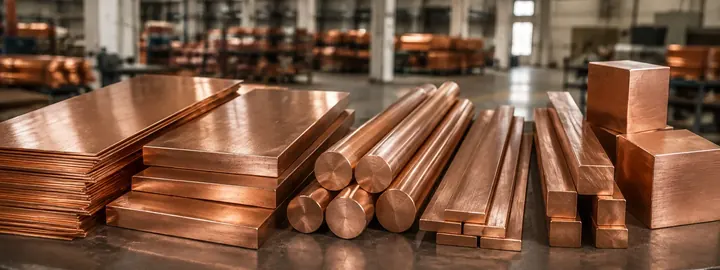
This table brings together the forms and sizes of the six coppers. Each column is a form, and the size appears under the copper that carries it:
| Copper | Plate | Round bar | Flat bar | Sheet |
|---|---|---|---|---|
| C11000 | 1/8" a 1/4" | 1/4" a 6" | 1/8" a 1-1/2" | 26 to 14 gauge |
| C17200 | 1/4" a 6" | 1/2" a 8" | — | — |
| C17510 | 1/2" a 3" | 1/2" a 3" | — | — |
| C18000 | 1/8" a 6" | 1/2" a 4" | — | — |
| C18150 | 1/4" a 4" | 1/4" a 8" | — | — |
| C18200 | 1/8" a 3" | 1/4" a 3" | — | — |
How to choose the right copper?
The simplest way to choose is to think about what you will ask of the part: conduct, withstand, or both.
- If what you need is to conduct electricity or heat as well as possible, the right copper is C11000 (electrolytic).
- If you want the maximum strength and hardness in a copper alloy, C17200 (beryllium) is the strongest.
- If you need good conductivity and strength at the same time, C17510 offers that balance.
- If you make resistance welding electrodes or wheels, the chromium coppers C18000, C18150 and C18200 are the right choice, depending on the conductivity and strength you need.
In summary
- Copper is the best commonly used metal for conducting electricity and heat
- Pure copper conducts best but is soft; alloys conduct somewhat less and hold up better
- C11000 is for conducting; the C17xxx and C18xxx grades are high-strength for welding and molds
- Chromium coppers (C18000, C18150 and C18200) are beryllium-free alternatives
Why buy your copper at NAT MAC?
We have been supplying metals to industry for more than 54 years and work with ISO 9001 certified quality. We help you choose the right copper based on what you need, conducting or withstanding, and deliver it cut to size.
- Electrolytic copper and high-strength alloys (beryllium and beryllium-free)
- Available in plate, bar, flat bar and sheet
- Advice on choosing the right copper for your conductivity and strength needs
- Cut to size
- Backed by ISO 9001 certified quality
Tell us what part you are going to make and in which copper alloy you need it, and we will give you pricing and availability right away. Request your free quote.
Sources: NAT MAC Metals data sheets and catalog; Copper Development Association, UNS Standard Designations for Copper and Copper Alloys; Copper Development Association, alloy database (alloys.copper.org).