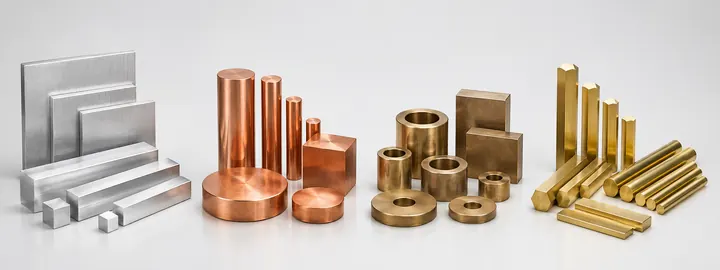
 Metals
How to read metal standards: aluminum, copper, bronze and brass
Non-ferrous metals are not named like steel. Aluminum, copper, bronze and brass have their own designation systems and equivalents. In this guide we explain how to read them, so you can order the right material and find its equivalent in any standard.
Why do metals have different standards than steel?
Steel is identified by the four-digit SAE/AISI system (4140, 1045, and so on). Nonferrous metals use other systems depending on their family. The most common are the UNS number (universal), the aluminum four-digit system, the SAE number for bronzes, plus ASTM/ASME, EN and DIN equivalents. Knowing them lets you compare materials across suppliers and countries.
The UNS number: the common thread
The UNS (Unified Numbering System) is the most widely used reference in Mexico and the United States. It is a letter plus five digits: A9xxxx for aluminum and Cxxxxx for copper and all its alloys (including brass and bronze). For example, 6061 aluminum is UNS A96061 and electrolytic copper is UNS C11000.
Aluminum standards: the four-digit system
Aluminum is identified by four digits (the Aluminum Association system). The first digit indicates the main alloying element:
| Series | Main alloying element | Example |
|---|---|---|
| 1xxx | Pure aluminum (99 % or more) | 1100 |
| 2xxx | Copper | 2024 |
| 3xxx | Manganese | 3003 |
| 4xxx | Silicon | 4043 |
| 5xxx | Magnesium | 5052 |
| 6xxx | Magnesium and silicon | 6061 |
| 7xxx | Zinc | 7075 |
After the number comes the temper, which indicates how the material was hardened: O annealed (soft), H strain hardened (for example H14, half-hard), T heat treated (for example T6 or T651, solution heat treated and aged), and F as fabricated. These are the equivalents for the aluminum alloys we carry:
| Aluminum | UNS | ASTM | EN | DIN |
|---|---|---|---|---|
| 3003-H14 | A93003 | B209 | AW-3003 | 3.0517 |
| 6061-T651 | A96061 | B209 y B211 | AW-6061 | 3.3211 |
| 7075-T651 | A97075 | B209 y B211 | AW-7075 | 3.4365 |
Copper, bronze and brass standards
Copper and all its alloys (including brass and bronze) are grouped in the UNS Cxxxxx system, organized by family: C1xxxx are coppers, C2xxxx through C4xxxx are brasses, and C8xxxx and C9xxxx are cast bronzes. Bronzes also carry an SAE number (SAE 40, 62, 64, 68, 660), and high-strength coppers an RWMA class. ASTM/ASME, EN and DIN equivalents are added on top of that.
Coppers:
| Copper | UNS | EN | DIN | JIS |
|---|---|---|---|---|
| Electrolytic (ETP) | C11000 | CW004A | 2.0060 | C1100 |
| C17200 (beryllium) | C17200 | CW101C | 2.1247 | C1720 |
| C17510 (Ni-beryllium) | C17510 | CW110C | 2.0850 | — |
| C18000 | C18000 | — | — | — |
| C18150 (Cr-Zr) | C18150 | CW106C | 2.1293 | — |
| C18200 (chromium) | C18200 | CW105C | 2.1291 | C1820 |
Bronzes: named by their SAE and UNS numbers.
| Bronze | UNS | ASTM | DIN | JIS |
|---|---|---|---|---|
| SAE 40 | C83600 | B62 / B584 / B505 | 2.1096 | CAC406 |
| SAE 62 | C90500 | B584 / B505 / B271 | 2.1050 | CAC403 |
| SAE 64 | C93700 | B584 / B505 / B271 | 2.1176 | CAC603 |
| SAE 68 | C95400 | B148 / B505 / B271 | 2.0940 | CAC702 |
| SAE 660 | C93200 | B584 / B505 / B271 | 2.1090 | — |
Brasses:
| Brass | UNS | Commercial | EN | DIN |
|---|---|---|---|---|
| C26000 (cartridge brass 70/30) | C26000 | CuZn30 | CW505L | 2.0265 |
| C36000 (free machining) | C36000 | CuZn36Pb3 | CW603N | 2.0375 |
In summary
- Nonferrous metals do not use the SAE/AISI steel system; each family has its own
- The UNS number is the common thread: A9xxxx for aluminum and Cxxxxx for copper and its alloys
- Aluminum uses 4 digits (the 1st digit is the alloying element) plus the temper (H, T, O, F)
- Copper, bronze, and brass use UNS Cxxxxx; bronzes also carry an SAE number
- There are always ASTM/ASME, EN and DIN equivalents for comparing materials
Why buy your metals at NAT MAC?
We have more than 54 years of experience as an industrial supplier and ISO 9001 certified quality. We carry aluminum, copper, bronze and brass, and we help you find the exact material or equivalent you need.
- Quality aluminum, copper, bronze and brass, backed and traceable
- We help you find the right equivalent between standards
- Material cut to the size you need
- Technical advice on choosing the right alloy
- On-time deliveries and competitive prices
Tell us what metal you are looking for or what standard it is specified to, and we will source the material or its equivalent. Request your free quote.
Sources: NAT MAC Metals data sheets and catalog; Copper Development Association, UNS Standard Designations for Copper and Copper Alloys; The Aluminum Association, Standards; The Aluminum Association, International Alloy Designations and Chemical Composition Limits (Teal Sheets); ASM Handbook Vol. 2, Alloy and Temper Designation Systems for Aluminum.