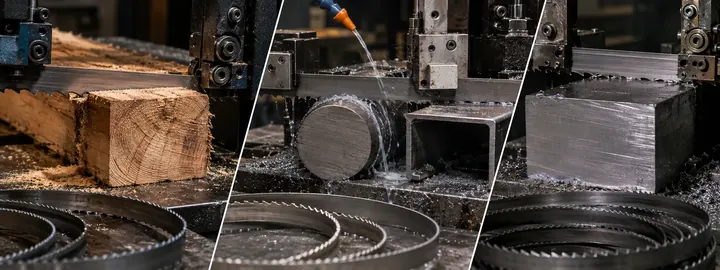
 Band Saw Blades
Which band saw blade to use for each material? Guide by application
Choosing the right band saw blade starts with the material you will cut. In this guide we tell you, material by material, which blade type suits and which line we carry for each case, so you get it right the first time and get the most out of your blade.
What does the choice depend on?
To choose the right band saw blade, look at three things:
- The material: how hard and abrasive it is. Common steel calls for a different blade than stainless or hardened steel.
- The shape of the part: cutting solid bar is not the same as cutting tube, profiles or a bundle of parts.
- Volume: for occasional cutting, an economical blade is fine; for high production, choose one that cuts fast and lasts longer.
With that in mind, here is the recommendation by material.
Table: which band saw blade to use by material
This table summarizes the recommended blade for each material and the line we carry:
| Material | Recommended blade | NAT MAC line |
|---|---|---|
| Carbon and structural steel (A36, 1018, 1045) | M42 bi-metal, pointed tooth | NATCUT M42-P or Starrett Intenss |
| Alloy / machinery-grade steel (4140, 4340) | M42 bi-metal (M51 if very hard) | NATCUT M42-P / M51-P |
| Stainless steel (304, 316) | M51 bi-metal (carbide in production) | NATCUT M51 / Starrett Advanz |
| Tool steel and hardened steel | M51 or negative-rake carbide | Starrett Advanz CS (up to 60 HRC) |
| Aluminum and non-ferrous | M42 bi-metal (carbide if abrasive) | NATCUT M42 / Starrett Advanz FS |
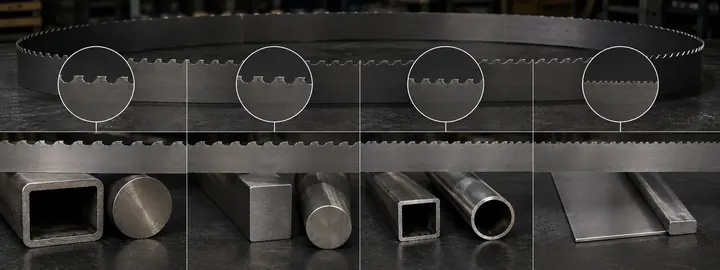
| Tube and structural shapes (hollow sections) | Bi-metal with tensor tooth and fine pitch | NATCUT M42-T |
| Bundles and packs of pieces | Bi-metal with turtle-back tooth | NATCUT M42-H |
| Abrasive and composite materials | Positive-rake carbide | Starrett Advanz FS |
| Aerospace alloys | Multi-chip carbide | Starrett Advanz MC5 |
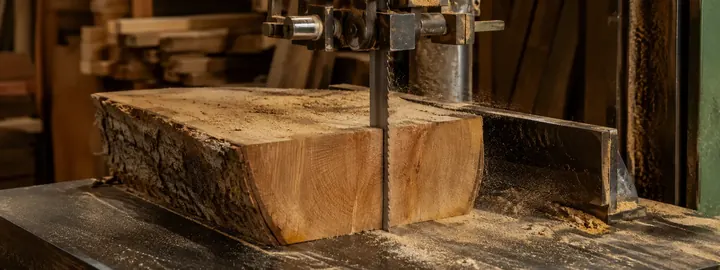
| Wood and non-metallics | Carbon steel | NATCUT Carbon or Starrett Duratec |
These are general recommendations; part thickness and your machine also matter. We are happy to fine-tune the choice with you.
By hardness: plain, stainless and hardened steels
The harder the material, the tougher the cutting edge must be. For everyday carbon and alloy steel, an M42 bimetal blade is enough. For stainless and harder steels, the M51 edge is the better choice, since it lasts longer. And for hardened materials or demanding production, carbide is best (for example, Advanz CS for case-hardened parts up to 60 HRC).
By shape: bar, tube, shapes and bundles
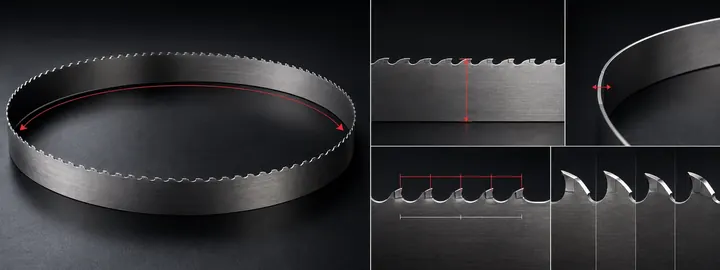
The shape of the workpiece determines the tooth profile. For solid bar and general work, use a pointed tooth (P). For tube and structural shapes (thin walls), use a tensor tooth (T) and a finer pitch, so that several teeth are always engaged in the material. For bundles and structurals, use a turtleback tooth (H), which withstands impact.
And what about the tooth pitch?
Besides the blade type, you need to get the pitch (teeth per inch) right, which depends on the thickness of the workpiece. We explain it in detail in our article on how to choose the band saw blade pitch.
In summary
- The blade is chosen by the material, the shape of the part and the cutting volume
- Common steel: M42 bi-metal; stainless and hard materials: M51; hardened steels and production: carbide
- Bar: P tooth; tube and structural shapes: T tooth; bundles: H tooth
- We carry NATCUT (our own line) and Starrett to cover every material
Why buy your band saw blades at NAT MAC?
We have more than 54 years of experience in the industry and ISO 9001 certified quality. We make our own NATCUT line and distribute Starrett, so we have the right blade for every material, and we deliver it welded to the size of your machine.
- Blades for every material: bi-metal (NATCUT and Starrett), carbide (Advanz) and carbon steel
- Advice on choosing the right blade and pitch for your material and machine
- Blades welded to length
- Our own NATCUT line with the best cost-benefit ratio
- Backed by ISO 9001 certified quality
Tell us what material you cut, in what shape and sizes, and we'll recommend the right band saw blade. Request your free quote.
Sources: NAT MAC Band saw blades catalog (NATCUT and Starrett); Starrett, Band Saw Blades; Starrett, Band Saw Blades Catalog 60.