 Plastics
What is acetal (POM) and when is it the right choice? Precision and dimensional stability
When a plastic part has to hold its dimensions and move smoothly for years, acetal is the first choice. In this guide we explain what acetal (POM) is, why it is the preferred plastic for gears, bearings, lead screws and high-tolerance machined parts, and what the difference is between POM-C copolymer and POM-H homopolymer.
What is acetal (POM)?
Acetal, or polyacetal (POM), is a highly crystalline thermoplastic with excellent mechanical strength, stiffness and good shock damping. It stands out for its dimensional stability, low coefficient of friction, low moisture absorption (0.2%) and outstanding machinability, making it ideal for precision parts.
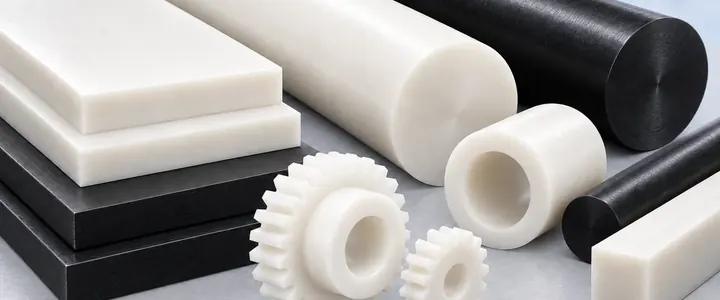
Made by extrusion in bars and plates, and available as virgin copolymer (POM-C) and homopolymer (POM-H), in white and black. Used in the mechanical, food, chemical and electrical industries.
Why choose this material?
Compared with metal parts or other plastics, it offers several advantages:
| Advantage | What does it mean? |
|---|---|
| Dimensional stability | Low moisture absorption (0.2%): parts keep their dimensions in continuous use |
| Stiffness and strength | Yield strength of 67 MPa and modulus of elasticity of 2,800 MPa |
| Low coefficient of friction | Smooth motion and good wear and fatigue resistance |
| Outstanding machinability | Excellent finish and tight tolerances in turning, milling and drilling |
| Good insulator and water resistant | Dielectric strength of 40 kV/mm and good performance in contact with water |
Technical properties
Reference values taken from our data sheet; they may vary depending on manufacturing and application conditions:
| Property | Unit | Value |
|---|---|---|
| Density | g/cm³ | 1.41 |
| Water absorption | % | 0.2 |
| Yield strength | MPa | 67 |
| Modulus of elasticity | MPa | 2,800 |
| Hardness | Shore D | 81 |
| Service temp. | °C | −50 a 100 |
| Melting temperature | °C | 165 |
| Dielectric strength | kV/mm | 40 |
Available package sizes
| Material | Available forms | Colors | Supply |
|---|---|---|---|
| Acetal (POM) | Round bars 1/4" – 12" (6.35 mm – 305 mm) · Plates 1/4" – 4¾" (6 mm – 121 mm) | White, Black | Extruded |
If you need a particular size, tell us which one and we will gladly source it for you.
Where is it used?
Some of the most common applications of this material in industry:
- Gears, pinions and cams
- Bearings, sleeves and rolling bearings
- Tight-tolerance machined parts
- Spindles and worm screws
- Springs, clips and fasteners
- Valve bodies
- Pump impellers
- Nozzles and sprayers
- Components in contact with water
- Guides and rollers
- Conveyor components
- Electrical insulators
How to choose?
- Precision parts with tight tolerances: acetal is the best choice for its dimensional stability and machinability.
- Parts in contact with water or moisture: its low water absorption prevents dimensional changes.
- If the part needs to slide under high load with little lubrication: compare it with self-lubricating Nylon AL; if precision is the priority, choose acetal.
- If the temperature exceeds 100 °C: consider PET or PEEK, which have a higher service temperature.
In summary
- Acetal (POM) is a rigid, low-friction thermoplastic, very dimensionally stable and very easy to machine
- Absorbs very little moisture (0.2%), so it keeps its dimensions in continuous use
- Available as copolymer (POM-C) and homopolymer (POM-H), in white and black
- It is the preferred material for gears, bearings, spindles, valve bodies and high-tolerance machined parts
Why buy your engineering plastics at NAT MAC?
We have more than 54 years of experience in the industry and ISO 9001 certified quality. We carry all ten families of engineering plastics (nylon, polyethylene, acetal, Teflon, polycarbonate, PEEK, PETG, PET, polypropylene and thermosets), each with its own data sheet, and we help you choose the right material for your part, your load and your working environment.
- Material cut to the size you need
- Data sheets with verified properties for each grade
- Advice on choosing the right plastic for your load, temperature and environment
- Stock in bars, plates and bushings with delivery throughout Mexico
- Backed by ISO 9001 certified quality
Tell us what part you'll make, the conditions it operates in and the sizes you need, and we'll recommend the right material. Request your free quote.
Sources: NAT MAC Engineering Plastics data sheets and catalog; TecnoQuim (material data sheets); ISO 527-1, Determination of tensile properties; ISO 868, Shore hardness.