 Metals
What is aluminum and which one should you choose? 3003, 6061 and 7075 explained
Aluminum is one of the most widely used metals in industry, and that is no accident: it is lightweight, resists corrosion and is easy to work. In this guide we explain what aluminum is, why it is so widely used and which three aluminums we carry at NAT MAC (3003, 6061 and 7075), so you can choose the right one for your part.
What is aluminum and why is it so widely used?
Aluminum is a lightweight metal: it weighs roughly one third of what steel weighs. Unlike steel, it does not rust, because it naturally forms a thin layer that protects it from the environment. On top of that, it conducts heat and electricity well and is easy to machine and shape. It does not reach the hardness or strength of steel, but when weight is a key factor, aluminum is often the best choice.
In practice, aluminum is almost never used pure. It is combined with other elements, such as magnesium, silicon, zinc, copper or manganese, to form alloys, and each alloy is designed for a different use. That is why you will find names like 6061 aluminum or 7075 aluminum: each number identifies an alloy with specific properties.
In names like 6061-T651 or 3003-H14, the letters indicate how the material was hardened. The letter T means it was hardened by heat treatment, that is, with heat (like 6061 and 7075). The letter H means it was hardened by cold working, that is, with mechanical work (like 3003, which cannot be heat treated).
The aluminums we carry at NAT MAC
We work with three aluminums, and each one meets a different need. This table summarizes them:
| Aluminum | What is it? | What is it best for? |
|---|---|---|
| 3003-H14 | General-purpose alloy, highly corrosion resistant and easy to form. It cannot be heat treated. | Sheet, covers, ducts and vessels |
| 6061-T651 | The most versatile. Medium-high strength, good corrosion resistance, good machinability and weldability. | Structures, machine bases and precision parts |
| 7075-T651 | The one with the highest mechanical strength. It supports very high loads at low weight, although it is less weldable. | High-demand parts, molds and racing |
Below we explain each one in more detail: what it is, what it is used for and in which sizes we stock it.
3003 aluminum: the choice for sheet and forming
3003 aluminum is a general-purpose aluminum-manganese alloy. Its main virtue is that it resists corrosion very well and bends, forms and welds easily. Since it cannot be heat treated, it does not harden with heat, so it is used mainly in sheet, in applications where ease of fabrication matters more than mechanical strength.
Typical applications: sheet metal and covers, ventilation ducts, tanks and vessels, utensils, signage, panels and facades, heat exchangers, and bent or deep-drawn parts.
Form we carry: sheet, from 26 gage to 16 gage.
6061 aluminum: the most versatile and balanced
6061 aluminum is the most widely used of the three and the most balanced. It is a magnesium-silicon alloy with medium-high strength, low weight and good corrosion resistance. Its great advantage is that it combines several qualities at once: it is strong, machines easily and welds well. Thanks to that balance, it serves an enormous variety of parts, from a machine base to a precision CNC-machined component.
Typical applications: machinery bases and plates, fixtures and tooling, structures and profiles, automotive components, precision machined (CNC) parts, molds and mold bases, welded assemblies and marine fittings.
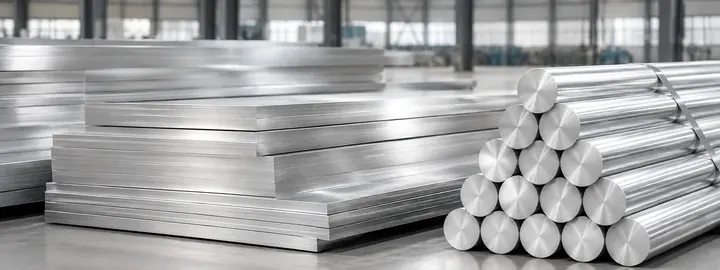
Forms we carry: plate (1/8" to 6"), round bar (1/4" to 12") and flat bar (1/4" to 1-1/2").
7075 aluminum: the highest-strength grade
7075 aluminum is the one with the highest mechanical strength. It is an aluminum alloy with zinc, magnesium and copper, and it stands out for its excellent strength-to-weight ratio: it supports very high loads without being heavy. In return, it is harder to weld and resists corrosion less than 6061, so it is reserved for parts that demand maximum strength.
Typical applications: shafts and mechanical components, fixtures and high-demand bases, parts subjected to high loads, racing and automotive components, and precision base plates.
Forms we carry: plate (1/4" to 6") and round bar (1" to 6").
Forms and sizes we carry
This table brings together the forms and sizes of the three aluminums we carry:
| Aluminum | Package size | Sizes |
|---|---|---|
| 3003 | Sheet | 26 to 16 gauge |
| 6061 | Plate | 1/8" a 6" |
| 6061 | Round bar | 1/4" a 12" |
| 6061 | Flat bar | 1/4" a 1-1/2" |
| 7075 | Plate | 1/4" a 6" |
| 7075 | Round bar | 1" a 6" |
How to choose the right aluminum?
The simplest way to choose is to start from what your part is going to do:
- If you will make sheet, covers or parts that are heavily bent or formed, the right aluminum is 3003.
- If you need a structural part, a machine base or a component that is machined and sometimes welded, choose 6061, the most versatile.
- If you need maximum strength to carry heavy loads without adding weight to the part, the right aluminum is 7075.
6061 and 7075 look alike at first glance, but they do not perform the same. If your part will carry demanding loads, do not settle for 6061; and if you do not need that much strength, do not overpay for 7075. If you have any questions, we are happy to advise you.
In summary
- Aluminum is lightweight, resists corrosion and is easy to work
- Each number (3003, 6061 and 7075) is a different alloy for a different use
- 3003 is for sheet and forming, 6061 is the most versatile and 7075 is the highest-strength
- The letters in the name (T651, H14) indicate how the material was hardened
Why buy your aluminum at NAT MAC?
We have been supplying metals to industry for more than 54 years and work with ISO 9001 certified quality. We help you choose the right aluminum for what you are going to make and deliver it cut to the size you need.
- 3003, 6061 and 7075 aluminum in plate, bar, flat bar and sheet
- Advice on choosing the right aluminum for your part
- Cut to size
- Backed by ISO 9001 certified quality
Tell us what part you are going to make and in which aluminum you need it, and we will give you pricing and availability right away. Request your free quote.
Sources: NAT MAC Metals data sheets and catalog; The Aluminum Association, Standards; The Aluminum Association, International Alloy Designations and Chemical Composition Limits (Teal Sheets); ASM Handbook Vol. 2, Alloy and Temper Designation Systems for Aluminum.