 Steel
SteelHow hard is steel? Rockwell, Brinell and Vickers explained
“How hard is this steel?” is one of the questions we get asked most, and rightly so: hardness decides whether a part will withstand wear or wear out in a short time. Here we explain, in plain terms, what hardness is, the scales used (Rockwell, Brinell and Vickers) and how hard each steel is.
What is steel hardness?
Hardness is how well a steel resists scratching, penetration or wear. It is measured in a very simple way: a point is pressed against the steel with a known force, and you see how deep or how large the mark is. The smaller and shallower the mark, the harder the steel.
Watch out for something important: hardness is not the same as strength or toughness. They are three different things:
- Hardness: resists scratching and wear (doesn't wear down from friction).
- Strength: bears load without deforming (doesn't bend or give way).
- Toughness: withstands blows without breaking (doesn't crack from an impact).
Harder is not always better. A very hard steel is usually more brittle, meaning it can break under a blow. The ideal is the right hardness for the job, not the maximum possible.
The hardness scales you will see most
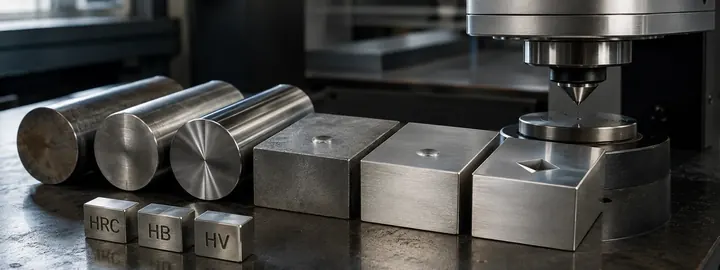
Hardness is measured on different scales. These are the three most used:
| Scale | Symbol | What it is used for | Example |
|---|---|---|---|
| Rockwell C | HRC | The most common for hardened or hard steels | 58 HRC |
| Rockwell B | HRB | For softer, unhardened steels | 90 HRB |
| Brinell | HB | Mild and medium steels, and large parts | 200 HB |
| Vickers | HV | Works for everything, from very soft to very hard | 600 HV |
In everyday metalworking, the one you will hear about most is Rockwell C (HRC): it is fast, reads as a single number, and is the one used for tool steels and hardened parts.
How are they related?
Because they measure the same thing (hardness), the scales can be converted from one to another approximately. This table is a quick reference:
| Rockwell C (HRC) | Brinell (HB) | Vickers (HV) |
|---|---|---|
| 20 | 226 | 238 |
| 30 | 286 | 302 |
| 40 | 371 | 392 |
| 50 | 481 | 513 |
| 60 | not applicable | 697 |
These are approximate reference values. The Brinell scale is not used on very hard steels (above 55 HRC), because the indentation no longer comes out well.
How hard is each steel? (reference)
The final hardness of a steel depends on its heat treatment. These are the typical hardnesses of the grades we carry most:
| Steel | Typical hardness | When? |
|---|---|---|
| 1018 | Soft (only the surface hardens through carburizing) | In its normal state |
| 1045 | Up to ~55 HRC | Hardened |
| 4140 | ~28 to 34 HRC (and up to ~50 HRC hardened) | Depends on the treatment |
| 4340 | ~28 a 40 HRC | Quenched and tempered |
| P20 | ~30 a 36 HRC | Pre-hardened (ready to machine) |
| H13 | ~44 a 52 HRC | Hardened |
| S7 | ~54 a 58 HRC | Hardened |
| O1 / A2 | ~57 a 62 HRC | Hardened |
| D2 | ~58 a 62 HRC | Hardened |
| M2 | ~62 a 65 HRC | Hardened |
| 420 (stainless) | ~48 a 54 HRC | Hardened |
| 304L / 316L (stainless) | Soft (they do not harden by quenching) | In its normal state |
So how much hardness do I need?
It depends on the job the part does. If it will suffer a lot of wear or rubbing (a knife, a die, a punch), you want a high-hardness steel, above 58 HRC. If it will take hard blows, you are better off lowering the hardness somewhat in exchange for toughness (which is why an impact steel like S7 runs at 54 to 58 HRC). And if it is a machine part that only works under load, a quenched and tempered steel at 28 to 34 HRC will do fine.
How is hardness measured?
Hardness is measured with a device called a hardness tester, which presses the point in and gives you the number directly. It is a quick test, widely used in quality control to confirm that a part has the correct hardness after heat treatment. At NAT MAC we carry measuring equipment, including hardness testers, in case you need to verify your parts.
In summary
- Hardness is how well steel resists scratching and wear
- The most widely used scale is Rockwell C (HRC); there are also Brinell (HB) and Vickers (HV)
- They can be converted approximately from one to another
- Harder is not better: too much hardness makes steel more brittle
Why buy your steel at NAT MAC?
We have been supplying steel to industry for more than 54 years and work with ISO 9001 certified quality. We help you choose the steel with the right hardness for your part and, if you need it, we also have measuring equipment to verify it.
- Carbon, alloy, tool and stainless steels
- Advice on choosing the right hardness for the job
- Cut to size
- Measuring equipment, including hardness testers
- Backed by ISO 9001 certified quality
Tell us what part you are going to make and how it will work, and we will help you choose the right steel and hardness. Request your free quote.
Sources: NAT MAC Steel data sheets and catalog; ASTM E18, Rockwell Hardness of Metallic Materials; ASTM E10, Brinell Hardness of Metallic Materials; ASM Handbook Vol. 4A, Steel Heat Treating Fundamentals and Processes.