 Steel
SteelSteel standards: SAE, AISI, DIN, EN and JIS explained
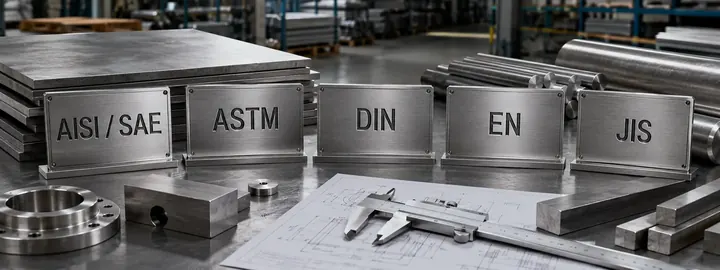
If you have ever ordered steel, you have surely run into odd names: 1045, A36, 42CrMo4, SUS304… Each one comes from a different standard (SAE, AISI, ASTM, DIN, EN or JIS), and the confusing part is that they are often the same steel under another name. Here we explain, in plain terms, what each standard is and how to read it.
What is a steel standard?
A standard is like a rulebook: it gets everyone to agree on what a steel is called, what it is made of and what it must meet. That way, when you order a steel by name, the maker, the seller and you all know you are talking about the same material.
The problem is that each country made its own standard. That is why the same steel can have three or four names, depending on where it comes from. Here we show you how to recognize them.
The standards you will see most
| Standard | Where it comes from | It is mainly used for | Example |
|---|---|---|---|
| SAE / AISI | United States | Carbon and alloy steels | 1045, 4140 |
| ASTM | United States | Structural plates and steels | A36, A572 |
| DIN | Germany | Steels in general | 1.7225 or 42CrMo4 |
| EN | Europe | It is replacing DIN, same style | 42CrMo4 |
| JIS | Japan | Steels in general | S45C, SUS304, SKD11 |
SAE and AISI (United States)
These are the two American standards and, for practical purposes, they are the same thing: one complements the other. They are the most widely used in Mexico, especially for carbon and alloy steels. Their trademark is four-digit names, such as 1045 or 4140.
They are very easy to read: the first two digits tell you the type of steel, and the last two tell you how much carbon it contains. For example, 1045 is a carbon steel with 0.45% carbon, and 4140 is an alloy steel with 0.40% carbon.
ASTM (United States)
ASTM is another American standard, but it works differently: it does not tell you what the steel is made of, but what it is for and what it must meet. It is used mainly for plates and structural shapes.
Their names start with the letter A followed by a number. For example: A36 is the most common structural plate, A572 is a stronger one, and A516 is for tanks and pressure vessels.
DIN and EN (Europe)
DIN is the German standard and EN is the European one, which is gradually replacing it. In Europe the same steel can be named in two ways, and you will come across both:
- By a number, like 1.7225. It works like a catalog code: it doesn't tell you what the steel is made of, it only identifies it.
- By composition, like 42CrMo4. This name does tell you what is in it: the "42" is the carbon (0.42%) and the letters are the metals it contains (Cr is chromium and Mo is molybdenum).
For example, American 4140 is called 1.7225 or 42CrMo4 in Europe. It is exactly the same steel, only the name changes.
JIS (Japan)
JIS is the Japanese standard. The practical part is that the first letters of the name tell you what type of steel it is:
- Starts with S and ends in C: it is carbon steel. S45C, for example, is the same as 1045.
- Starts with SUS: it is stainless steel. SUS304 is 304 stainless.
- Starts with SKD: it is tool steel. SKD11 is the same as D2.
The same steel, different names
This is the most useful part of all: often the steel you are looking for is the same one, just with a different name depending on the standard. This table shows the equivalents of the grades we handle most:
| SAE / AISI | DIN (number) | European name | JIS (Japan) |
|---|---|---|---|
| 1045 | 1.1191 | C45 | S45C |
| 4140 | 1.7225 | 42CrMo4 | SCM440 |
| 4340 | 1.6565 | 40NiCrMo6 | SNCM439 |
| D2 | 1.2379 | X153CrMoV12 | SKD11 |
| H13 | 1.2344 | X40CrMoV5-1 | SKD61 |
| A2 | 1.2363 | X100CrMoV5 | SKD12 |
| O1 | 1.2510 | 100MnCrW4 | SKS3 |
| 304L | 1.4306 | X2CrNi18-9 | SUS304L |
| 316L | 1.4404 | X2CrNiMo17-12-2 | SUS316L |
| 420 | 1.2083 | X42Cr13 | SUS420J2 |
When you order steel, tell us the name you have at hand, regardless of the standard (AISI, DIN, JIS…), and what you will use it for. With that we confirm the exact equivalent and avoid confusion.
In summary
- SAE / AISI: 4-digit names; the last 2 digits are the % of carbon (1045 = 0.45%)
- ASTM: for plate and structurals; starts with an A and a number (A36, A572)
- DIN / EN (Europe): by a number (1.7225) or by its composition (42CrMo4)
- JIS (Japan): the first letter tells the type: S carbon, SUS stainless, SKD tool steel
Why buy your steel at NAT MAC?
We have been supplying steel to industry for more than 54 years and work with ISO 9001 certified quality. We carry carbon, alloy, tool and stainless steels, and we help you identify the right grade no matter which standard you know it by.
- Extensive catalog of carbon, alloy, tool and stainless steels
- We confirm equivalents between AISI, DIN, EN and JIS
- Cut to size
- Advice on choosing the right grade
- Backed by ISO 9001 certified quality
Tell us which steel you have or what you need to make, regardless of the standard, and we'll help you identify the right grade and form. Request your free quote.
Sources: NAT MAC Steel data sheets and catalog; ASTM International (ASTM standards); Total Materia, Introducción al sistema de designación SAE-AISI.