 Lubricants
What are hot forging lubricants and which one should you choose? ORAFOR and CONDAFORGE
In hot forging, the lubricant is what separates an efficient operation from tooling that wears out fast and parts that come out poorly formed. In this guide we explain what hot forging is, what the lubricant is for in this process, and which lines we carry at NAT MAC: ORAFOR and CONDAFORGE, from the CONDAT brand.
What is hot forging and why does it need lubricant?
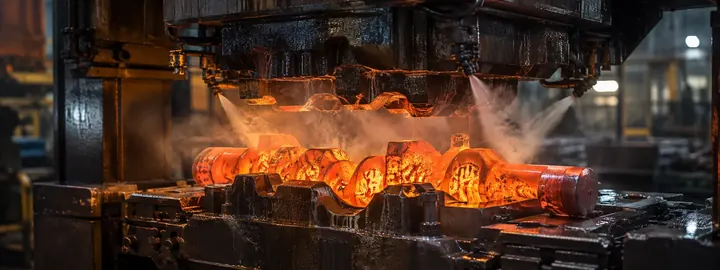
Hot forging is a process in which metal is shaped by hammering or pressing it while at high temperature, inside molds called dies. It is the way to make strong parts such as crankshafts, shafts, railway wheels and valve bodies.
At those temperatures, hot metal tends to stick to the dies, wear them down and not fill the shape properly. Forging lubricant solves exactly that: it forms a film between the metal and the tool that reduces friction, protects the dies, helps the metal flow and fill the cavity, and makes it easier to release the part from the die. Without a good lubricant, dies last less and production gets complicated.
What is a hot forging lubricant for?
A good forging lubricant performs four main functions:
| Function | What does it do? |
|---|---|
| High-temperature lubrication | Forms a stable film between the hot metal and the tool, and reduces friction |
| Tooling protection | Reduces wear on dies and extends their service life |
| Better metal flow | Helps fill the die cavity, form complex parts and release the part from the die |
| Cleaner operation | Reduces fumes, residue and deposits on tooling |
The hot forging lubricants we carry
We carry two CONDAT lines for hot and warm forging, both water-based. The main difference is whether or not they contain graphite. This table summarizes them:
| Product | What is it? | When to use it? |
|---|---|---|
| ORAFOR® | Water-based synthetic lubricant, graphite-free | Medium-complexity forging, when maximum cleanliness is sought |
| CONDAFORGE® | Water-based graphite lubricant | Demanding forging and complex geometries, in ferrous and non-ferrous metals |
ORAFOR: graphite-free synthetic lubricant
ORAFOR is CONDAT's line of water-based synthetic lubricants for hot and warm forging. Being graphite-free, it offers excellent adhesion on hot surfaces with very low residue generation, which means cleaner tooling and a more orderly work environment. It is designed for medium-complexity forging operations that require efficient lubrication, easy tooling cleanup and a stable film at high temperature.
Typical applications: hot forging of steel, warm forging of ferrous metals, manufacturing of valve bodies and railway wheels, upsetting operations, die and mold lubrication, and production lines with automatic spray systems.
CONDAFORGE: graphite lubricant for demanding applications
CONDAFORGE is CONDAT's line of water-based graphite lubricants for hot and warm forging of ferrous and non-ferrous metals. Its high-strength graphite film offers great lubricity and adhesion on hot tooling and promotes uniform metal flow, even in very demanding deformation operations. Thanks to its graphite dispersion technology, it extends the life of dies and matrices, improves part release and reduces lubricant consumption.
Typical applications: hot forging of steel, aluminum and brass forging, hot extrusion, crankshaft manufacturing, automotive component production, precision parts and forging preforms.
ORAFOR or CONDAFORGE? How to choose
The choice depends on how demanding the process is and how clean you want the operation to be:
- If you want maximum cleanliness and work medium-complexity parts, the choice is ORAFOR (graphite-free).
- If you need maximum performance on complex-geometry or highly demanding parts, or if you forge nonferrous metals such as aluminum and brass, the choice is CONDAFORGE (graphite-based).
Both ORAFOR and CONDAFORGE are free of ammonia, phosphates and heavy metals. This reduces fumes and makes tooling maintenance easier, for a cleaner work environment.
In summary
- In hot forging the lubricant reduces friction, protects the dies and helps form the part properly
- We carry two CONDAT water-based lines: ORAFOR (graphite-free) and CONDAFORGE (with graphite)
- ORAFOR is for medium complexity and maximum cleanliness; CONDAFORGE for high-demand work and nonferrous metals
- Both are free of ammonia, phosphates and heavy metals
Why buy your lubricants at NAT MAC?
We are a CONDAT distributor with more than 54 years of experience in the industry and ISO 9001 certified quality. We don't just supply the lubricant: we analyze your forging process and recommend the right line for your operation.
- CONDAT hot forging lubricants: ORAFOR and CONDAFORGE
- Assessment of your process to recommend the right lubricant
- Technical advice and on-site support at your plant
- Different package sizes to match your consumption
- Backed by ISO 9001 certified quality
Tell us about your forging process and what parts you produce, and we'll recommend the right line. Request your free quote.
Sources: NAT MAC Lubricants catalog; CONDAT Lubricants; CONDAT, Forging lubricants.