 Plastics
What is industrial PET and when to choose it? Stiffness and precision in machined parts
PET is not just the plastic used for bottles: in its industrial version, semicrystalline and in rods and sheets, it is one of the best materials for precision machined parts subject to load and wear. In this guide we explain what industrial PET is, how it is similar to acetal and where it outperforms it, and when it makes sense to choose it.
What is industrial PET?
PET (polyethylene terephthalate) is a semicrystalline thermoplastic with great stiffness and tensile strength (85 MPa yield and 3,000 MPa modulus), with dimensional stability comparable to that of acetal (POM). It combines very low moisture absorption (0.25%), a low coefficient of friction and excellent abrasion and tear resistance, with low creep and easy machining.
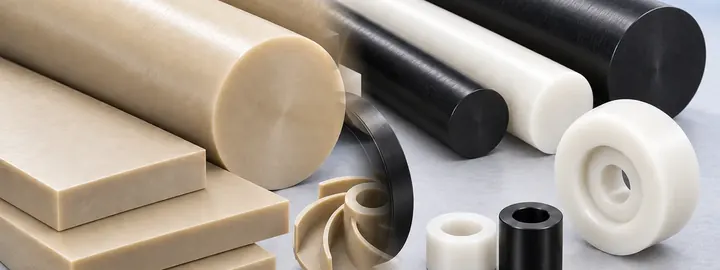
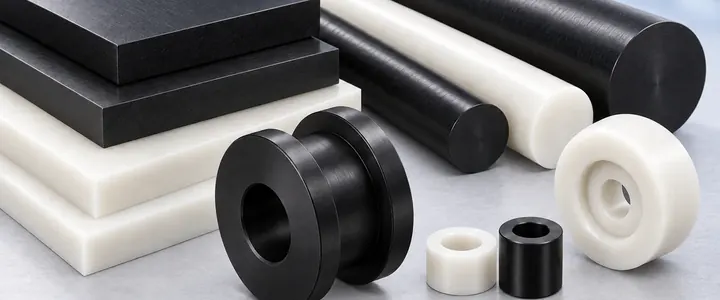
Operates from −20 to 115 °C in continuous service (180 °C short-term) and delivers an excellent finish when machined. We supply it in round bars and extruded plates, in black and white, with FDA-compliant grades for the food industry on request.
Why choose this material?
Compared with metal parts or other plastics, it offers several advantages:
| Advantage | What does it mean? |
|---|---|
| Stiffness and strength | 85 MPa yield strength and 3,000 MPa modulus: supports heavy loads without deforming |
| Dimensional stability | 0.25% water absorption and low creep; parts hold their dimensions |
| Abrasion resistance | Excellent wear and tear resistance in parts subject to friction |
| Higher temperature than acetal | Continuous service up to 115 °C (acetal reaches 100 °C) |
| Food safe | FDA-compliant grades available on request |
Technical properties
Reference values taken from our data sheet; they may vary depending on manufacturing and application conditions:
| Property | Unit | Value |
|---|---|---|
| Density | g/cm³ | 1.38 |
| Water absorption | % | 0.25 |
| Yield strength | MPa | 85 |
| Modulus of elasticity | MPa | 3,000 |
| Shore hardness | D scale | 84 |
| Melting temp. | °C | 255 |
| Service temp. (long-term) | °C | −20 a 115 |
| Service temp. (short-term) | °C | 180 |
| Dielectric strength | kV/mm | 20 |
Quick comparison
| Property | PET | Acetal (POM) |
|---|---|---|
| Yield strength | 85 MPa | 67 MPa |
| Modulus of elasticity | 3,000 MPa | 2,800 MPa |
| Water absorption | 0.25% | 0.2% |
| Hardness | 84 Shore D | 81 Shore D |
| Continuous service temperature | −20 a 115 °C | −50 a 100 °C |
| Melting temperature | 255 °C | 165 °C |
Available package sizes
| Material | Available forms | Colors | Supply |
|---|---|---|---|
| PET Polyester | Round bars 1/4" – 12" (6.35 mm – 305 mm) · Plates 1/4" – 4¾" (6.35 mm – 121 mm) | White, Black | Extruded |
If you need a particular size, tell us which one and we will gladly source it for you.
Where is it used?
Some of the most common applications of this material in industry:
- Gears and pinions
- Levers and handles
- Control discs and cams
- Bearings and bushings
- Sliding elements
- Precision parts
- Wear components
- Guides and rollers
- Mechanical engineering parts
- Electronic components
- Shipbuilding parts
- Material handling equipment
How to choose?
- Precision parts with heavy load and wear: PET, for its rigidity and abrasion resistance.
- Operating temperature between 100 and 115 °C: PET, which outperforms acetal in service temperature.
- Food processing components: FDA-grade PET.
- If the part operates below −20 °C or needs maximum toughness: compare it with acetal (−50 °C) or nylon.
In summary
- Industrial PET is rigid (85 MPa), very dimensionally stable and abrasion resistant
- Absorbs very little moisture (0.25%) and works up to 115 °C in continuous service
- Competes with acetal in precision parts and outperforms it in stiffness and temperature
- We carry it in bars from 1/4" to 12" and plates from 1/4" to 4¾", in black and white, with FDA grades on request
Why buy your engineering plastics at NAT MAC?
We have more than 54 years of experience in the industry and ISO 9001 certified quality. We carry all ten families of engineering plastics (nylon, polyethylene, acetal, Teflon, polycarbonate, PEEK, PETG, PET, polypropylene and thermosets), each with its own data sheet, and we help you choose the right material for your part, your load and your working environment.
- Material cut to the size you need
- Data sheets with verified properties for each grade
- Advice on choosing the right plastic for your load, temperature and environment
- Stock in bars, plates and bushings with delivery throughout Mexico
- Backed by ISO 9001 certified quality
Tell us what part you'll make, the conditions it operates in and the sizes you need, and we'll recommend the right material. Request your free quote.
Sources: NAT MAC Engineering Plastics data sheets and catalog; TecnoQuim (material data sheets); ISO 527-1, Determination of tensile properties; ISO 868, Shore hardness.