 Plastics
What is polycarbonate and when to use it instead of glass? Guards and protective covers
When a protective cover has to be transparent and also withstand impact, glass falls short. Polycarbonate offers exceptional impact resistance at much lower weight, which is why it is the material for machine guards, safety partitions, domes and skylights. In this guide we explain what polycarbonate is, what sets it apart from glass and PETG, and when to use it.
What is polycarbonate (PC)?
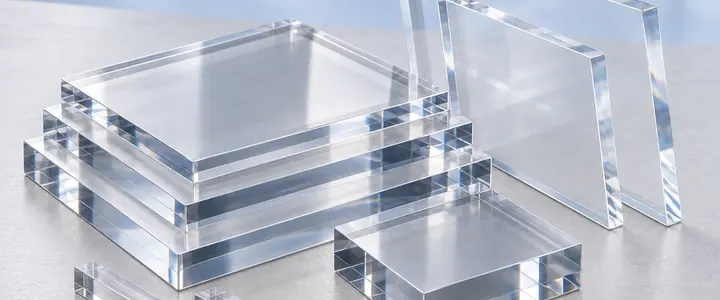
Polycarbonate is a transparent amorphous thermoplastic with exceptional impact resistance, virtually unbreakable, and 90% light transmission. It is lightweight (1.2 g/cm³), offers good sound insulation, a wide service temperature range (−50 to 100 °C) and is easy to cut, form and turn.
For outdoor use it is available in grades with weather and UV protection. We carry it in clear extruded plates of 1,220 × 2,440 mm, in thicknesses from 1/8" to 1/2".
Why choose this material?
Compared with metal parts or other plastics, it offers several advantages:
| Advantage | What does it mean? |
|---|---|
| Virtually unbreakable | 158 J drop impact: protects people and equipment without losing visibility |
| Clear | 90% light transmission; lets you see the process through the guard |
| Much lighter than glass | Density of 1.2 g/cm³; easy to install and no risk of splintering |
| Weather resistant | UV-protected grades for domes, skylights and enclosures |
| Easy to fabricate | Cut, machined and thermoformed to fit each design |
Technical properties
Reference values taken from our data sheet; they may vary depending on manufacturing and application conditions:
| Property | Unit | Value |
|---|---|---|
| Density | g/cm³ | 1.2 |
| Light transmission | % | 90 |
| Tensile modulus | MPa | 2,300 |
| Flexural strength | MPa | 100 |
| Drop impact (E50) | J | 158 |
| Rockwell hardness | R scale | 125 |
| Deflection temp. (HDT) | °C | 130 |
| Service temp. (long-term) | °C | −50 a 100 |
Quick comparison
| Feature | Polycarbonate (PC) | PETG |
|---|---|---|
| Impact resistance | Exceptional (158 J); practically unbreakable | Buena; resiste golpes moderados |
| Light transmission | 90% | 88% |
| Service temperature | −50 a 100 °C (HDT 130 °C) | Up to 60 °C (HDT 72 °C) |
| Forming | Easy to form and turn | Excellent thermoforming, even in heavy gauges and without pre-drying |
| Typical use | Guards, partitions, domes, shielding | Displays, display stands, covers and thermoformed parts |
Available package sizes
| Material | Available forms | Colors | Supply |
|---|---|---|---|
| Polycarbonate (PC) | Plates 1/8" – 1/2" (3 mm – 12.7 mm) | Clear | Extruded |
If you need a particular size, tell us which one and we will gladly source it for you.
Where is it used?
Some of the most common applications of this material in industry:
- Safety glazing and armoring
- Machine guards
- Glazing in schools and public buildings
- Bus shelter panels
- Police shields
- Boat, train and aircraft windows
- Automotive wind deflectors
- Eye shields on helmets
- Transparent noise barriers
- Architectural roofing
- Skylights and walkways
- Translucent domes and covers
How to choose?
- Machine guards, partitions and safety shields: polycarbonate, for its impact resistance.
- Domes, skylights and outdoor enclosures: polycarbonate with UV protection.
- Fixtures, displays and thermoformed parts: PETG, easier to thermoform and cold-bend.
- If you need a thickness greater than 1/2": tell us the size and we'll gladly source it for you.
In summary
- Polycarbonate is transparent (90% light transmission) and virtually unbreakable
- Weighs much less than glass and does not splinter; works from −50 to 100 °C
- We carry it in plates from 1/8" to 1/2" measuring 1,220 × 2,440 mm, with UV protection option
- For easy thermoforming and displays, PETG is the alternative; for impact and safety, polycarbonate
Why buy your engineering plastics at NAT MAC?
We have more than 54 years of experience in the industry and ISO 9001 certified quality. We carry all ten families of engineering plastics (nylon, polyethylene, acetal, Teflon, polycarbonate, PEEK, PETG, PET, polypropylene and thermosets), each with its own data sheet, and we help you choose the right material for your part, your load and your working environment.
- Material cut to the size you need
- Data sheets with verified properties for each grade
- Advice on choosing the right plastic for your load, temperature and environment
- Stock in bars, plates and bushings with delivery throughout Mexico
- Backed by ISO 9001 certified quality
Tell us what part you'll make, the conditions it operates in and the sizes you need, and we'll recommend the right material. Request your free quote.
Sources: NAT MAC Engineering Plastics data sheets and catalog; TecnoQuim (material data sheets); ISO 527-1, Determination of tensile properties; ISO 868, Shore hardness.