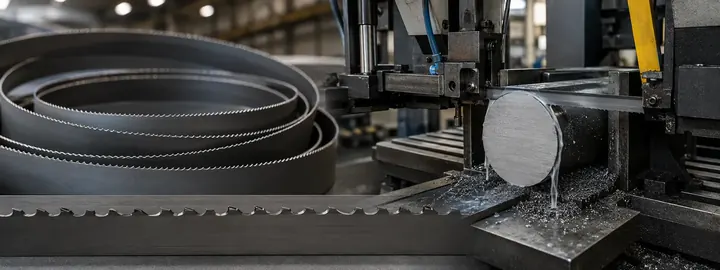
 Band Saw Blades
What is a bi-metal band saw blade and which one should you choose? NATCUT and Starrett
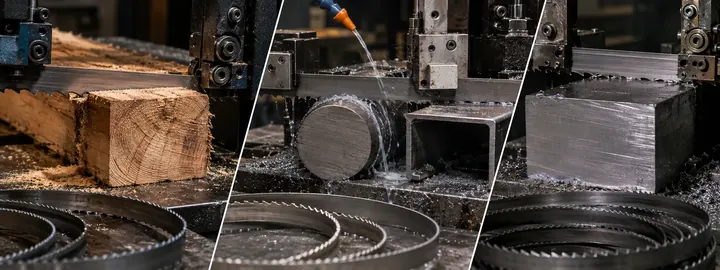
The bi-metal band saw blade is the blade most workshops use to cut metal, because it combines a very hard cutting edge with a flexible back that does not break. In this guide we explain what a bi-metal band saw blade is, why it makes sense, how to choose the edge and the tooth profile, and which ones we carry at NAT MAC: our own NATCUT line and the Starrett brand.
What is a bi-metal band saw blade?
A bi-metal band saw blade is a blade made of two different metals, hence the name "bi-metal". The edge, where the teeth are, is high-speed steel (HSS), a very hard steel that cuts well and resists wear. That edge is welded to a high-alloy steel backing that is flexible and fatigue-resistant, which is what lets the blade bend around the machine's wheels without breaking.
That combination is what makes it so popular: it takes the best of each metal, a tooth that cuts hard and lasts long, and a flexible body that does not break. That is why the bi-metal blade is the standard for cutting metal in industry.
Why choose a bi-metal blade?
Compared with a carbon steel blade, the bi-metal blade offers several advantages:
| Advantage | What does it mean? |
|---|---|
| Long life | A high-speed steel edge lasts much longer than that of a carbon steel blade |
| Cuts hard materials | Handles alloy steels, stainless and tool steels |
| Does not break easily | The flexible back withstands the fatigue of bending over and over |
| Better cost per cut | Although it costs more than a carbon blade, it lasts much longer and costs less per cut |
M42 and M51: which edge to choose?
The edge of bi-metal blades is made from two types of high-speed steel. The difference is in hardness and in the type of material you will cut:
| Cutting edge | What is it? | For what material? |
|---|---|---|
| M42 | High-speed steel with 8% cobalt, 68 HRC | General purpose; the most versatile choice for everyday work |
| M51 | Powder-metallurgy high-speed steel with high cobalt, 70 HRC | High-hardness materials: stainless, die steels and alloy steels |
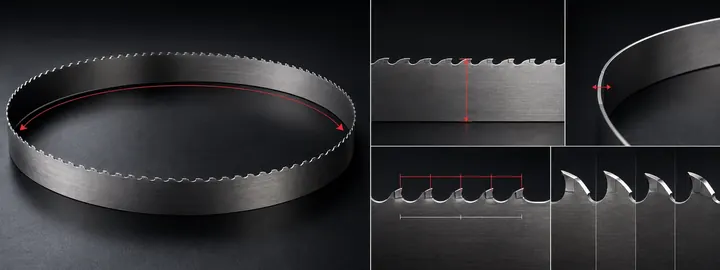
Tooth profile: P, T and H
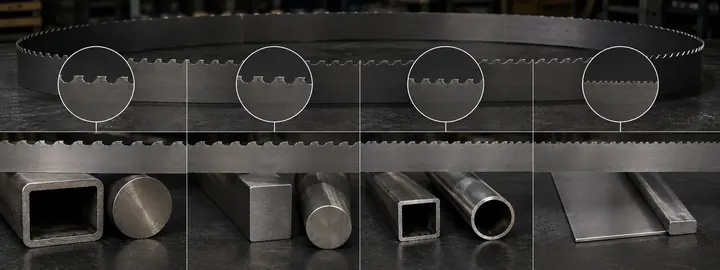
Besides the cutting edge, the tooth profile (shape) changes depending on what you are going to cut. These are the three we carry in the NATCUT line:
| Profile | What is it for? | Ideal for |
|---|---|---|
| P — Pointed | General-purpose cutting under standard conditions | Solid bar and a wide variety of shapes |
| T — Tensile | Prevents excessive penetration and reduces vibration | Tube and structural shapes (hollow sections) |
| H — Turtle-Back | Maximum tooth strength under high load and impact | Cutting of bundles and stacks, and metal structures |
NATCUT: our own line of band saw blades
NATCUT is NAT MAC's line of bi-metal band saw blades, our own brand. It is made with an M42 high-speed steel edge (68 HRC) or powder-metallurgy M51 (70 HRC) on a high-alloy, fatigue-resistant back, and is offered in all three tooth profiles to cover every type of cut. It is the option with the best cost-benefit ratio in our catalog.
| NATCUT model | Cutting edge | What for? |
|---|---|---|
| M42-P | M42 (68 HRC) | General purpose, bar and shapes |
| M42-T | M42 (68 HRC) | Tube and structural shapes (hollow sections) |
| M42-H | M42 (68 HRC) | Heavy load, bundle cutting and structures |
| M51-P | M51 (70 HRC) | High hardness, general purpose |
| M51-T | M51 (70 HRC) | High hardness, tube and structural shapes |
Starrett: the world reference brand
We also carry Starrett bi-metal band saw blades, one of the most prestigious brands in the world of cutting. Their range covers everything from the maintenance shop to the most demanding production lines:
| Starrett line | What is it used for? |
|---|---|
| Primalloy™ | Extended Life treatment; maximum fatigue life and high production |
| Intenss™ | Workshops, toolrooms and maintenance (light machines) |
| Intenss™ PRO | Production cutting in ferrous and nonferrous metals |
| Intenss™ PRO-DIE | Contour cutting on vertical machines (Split Chip and multi-edge) |
| Intenss™ PRO-VTH | Fast cuts, with variable tooth height and set |
| Versatix™ MP | Structural materials |
| Univerz™ | Portable machines |
How to choose the right bi-metal band saw blade?
The choice is defined by three things: the material, the shape of the part and the level of demand:
- By material: for common steel and general work, an M42 edge; for hard materials such as stainless or tool steels, an M51 edge.
- By part shape: solid bar and profiles with P tooth; tube and profiles with T tooth; bundles and structurals with H tooth.
- By brand: our NATCUT line gives you the best value for the money; Starrett is the premium option for maximum production and special applications.
In summary
- The bi-metal band saw blade joins a high-speed steel cutting edge (hard) with a flexible back (that does not break)
- It is the standard for cutting metal: long life, cuts hard materials and a better cost per cut
- The M42 edge is for general work and the M51 for high-hardness materials
- We carry our own NATCUT line and the Starrett brand, with P, T and H tooth profiles
Why buy your band saw blades at NAT MAC?
We have more than 54 years of experience in the industry and ISO 9001 certified quality. We make our own NATCUT line and distribute Starrett, so we offer everything from the best cost-benefit option to maximum performance, and we help you choose the right blade for your machine and your material.
- Our own NATCUT line (M42 and M51) and the Starrett brand
- The three tooth profiles: pointed, tension and turtle-back
- Advice on choosing the edge, profile and pitch for your material
- Blades welded to the length of your machine
- Backed by ISO 9001 certified quality
Tell us what material you cut, on what machine and in what dimensions, and we will recommend the right band saw blade. Request your free quote.
Sources: NAT MAC Band saw blades catalog (NATCUT and Starrett); Starrett, Band Saw Blades; Starrett, Band Saw Blades Catalog 60.