 Plastics
What are thermosets? Bakelite, Celoron, G10/FR4 and G11: which one to choose
When a part has to insulate against electrical current, carry load and keep its shape under heat, conventional plastics are not enough. That is where thermoset laminates come in: Bakelite, Celoron, G10/FR4 and G11. In this guide we explain what they are, how they differ in reinforcement and thermal class, and which one suits each application.
What are thermosets?
Thermosets are industrial laminates made by impregnating a reinforcement (paper, cotton cloth or fiberglass fabric) with a resin (phenolic or epoxy) and hot-pressing it under high pressure. Unlike thermoplastics, they do not melt: once cured, they keep their shape even at high temperature.
They offer excellent dielectric properties, dimensional stability and mechanical, thermal, chemical and moisture resistance. They are supplied in plates for cutting and machining. The combination of reinforcement and resin defines each material: phenolic paper (Bakelite), phenolic cloth (Celoron) and glass-epoxy (G10/FR4 and G11).
Why choose this family?
Compared with metal parts or other plastics, it offers several advantages:
| Advantage | What does it mean? |
|---|---|
| Electrical insulation | Dielectric strength of 22 kV/mm in Bakelite and above 13 kV/mm in G10 and G11 |
| They do not melt | They hold their shape with temperature: 135 °C operating temperature in phenolics and up to 180 °C in G11 |
| Mechanical strength | G10/FR4 and G11 exceed 250 MPa tensile strength |
| Stability and moisture resistance | Stable laminates in boards, transformers and electrical equipment |
| Machinable | They allow cutting and fine machining for gears, spacers and supports |
The four laminates we carry
These are the variants available at NAT MAC and what each one is best for:
| Laminate | Reinforcement and resin | Ideal for |
|---|---|---|
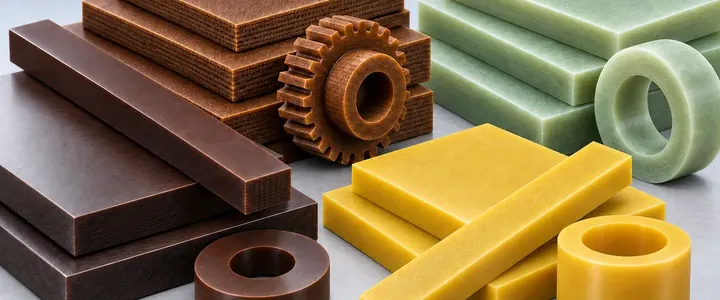
| Bakelite | Cellulose paper + phenolic resin; dark brown; also called Micarta or Pertinax | Electrical insulation, oil-immersed transformers, motors, hot sticks and spool supports |
| Celoron | Cotton cloth + phenolic resin; mechanical-electrical grade; dark brown | Gears and pinions, electrical insulation, and parts that require fine machining and impact resistance |
| G10 / FR4 | Fiberglass fabric + epoxy resin; flame retardant; Class F (155 °C); light green | Electrical and thermal insulation with high temperature and high mechanical stress |
| G11 | Fiberglass fabric + high-temperature epoxy resin; Class H (180 °C); yellow | Like G10 but with a higher service temperature |
Technical properties
Reference values taken from our data sheets; they may vary depending on manufacturing and application conditions:
| Property | Bakelite | Celoron | G10 / FR4 | G11 |
|---|---|---|---|---|
| Density | 1.34 g/cm³ | 1.35 g/cm³ | 1.9 – 2.0 g/cm³ | 1.9 – 2.0 g/cm³ |
| Water absorption | 1.30 % | 1.60 % | 40 mg | 40 mg |
| Tensile strength | 843 kg/cm² | 703 kg/cm² | > 250 MPa | > 250 MPa |
| Modulus of elasticity | 7,500 MPa | — | — | — |
| Charpy impact | 1.5 KJ/m² | — | > 22 KJ/m² | > 22 KJ/m² |
| Dielectric strength | 22 kV/mm | — | > 13 kV/mm | > 13 kV/mm |
| Continuous service temperature | 135 °C | 135 °C | 155 °C (Class F) | 180 °C (Class H) |
| UL 94 flammability | V0 / V1 | — | Flame retardant (FR4) | — |
Available package sizes
| Material | Available forms | Colors | Supply |
|---|---|---|---|
| Bakelite | Plates 1/32" – 4" (1 mm – 100 mm) | Dark brown | Hot-pressed |
| Celoron | Plates 1/64" – 5" (0.4 mm – 127 mm) | Dark brown | Hot-pressed |
| G10 / FR4 | Plates 5/16" – 4" (8 mm – 100 mm) | Light green | Hot-pressed |
| G11 | Plates 5/64" – 2" (2 mm – 50 mm) | Yellow | Hot-pressed |
If you need a particular size, tell us which one and we will gladly source it for you.
Where is it used?
Some of the most common applications of these materials in industry:
- Electrical insulator
- Oil-immersed transformers
- Air-cooled transformers
- Electric motors
- Radio components
- Hot sticks
- Screw protection
- Spool holders
- Mechanical applications in machinery
- Insulating spacers and barriers
- Insulating bases and supports
- Dielectric parts
How to choose?
- General-purpose electrical insulation and transformers: Bakelite, the phenolic laminate with the highest dielectric strength (22 kV/mm).
- Gears, pinions and mechanical parts under impact: Celoron, in mechanical-electrical grade and with fine machining.
- High temperature with mechanical stress and flame retardancy: G10/FR4, Class F (155 °C).
- Very high temperature: G11, Class H (180 °C), superior to G10/FR4.
In summary
- Thermosets are reinforcement + resin laminates hot-pressed that do not melt and insulate against electricity
- Bakelite (paper phenolic) and Celoron (cloth phenolic) operate up to 135 °C; G10/FR4 (Class F) up to 155 °C and G11 (Class H) up to 180 °C
- G10 and G11 glass-epoxy exceed 250 MPa tensile strength
- Choose by temperature, mechanical demand and flame retardancy requirement
Why buy your engineering plastics at NAT MAC?
We have more than 54 years of experience in the industry and ISO 9001 certified quality. We carry all ten families of engineering plastics (nylon, polyethylene, acetal, Teflon, polycarbonate, PEEK, PETG, PET, polypropylene and thermosets), each with its own data sheet, and we help you choose the right material for your part, your load and your working environment.
- Material cut to the size you need
- Data sheets with verified properties for each grade
- Advice on choosing the right plastic for your load, temperature and environment
- Stock in bars, plates and bushings with delivery throughout Mexico
- Backed by ISO 9001 certified quality
Tell us what part you'll make, the conditions it operates in and the sizes you need, and we'll recommend the right material. Request your free quote.
Sources: NAT MAC Engineering Plastics data sheets and catalog; TecnoQuim (material data sheets); ISO 527-1, Determination of tensile properties; ISO 868, Shore hardness.