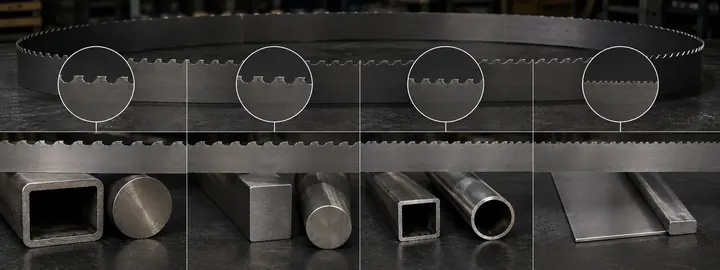
 Band Saw Blades
What is a carbide band saw blade and when is it worth it? Starrett Advanz
When you need to cut very hard materials or produce at high speed, the carbide band saw blade delivers the best results. In this guide we explain what a carbide band saw blade is, where it beats bi-metal, how its tooth geometry works and which ones we carry at NAT MAC: the Advanz line from Starrett.
What is a carbide band saw blade?
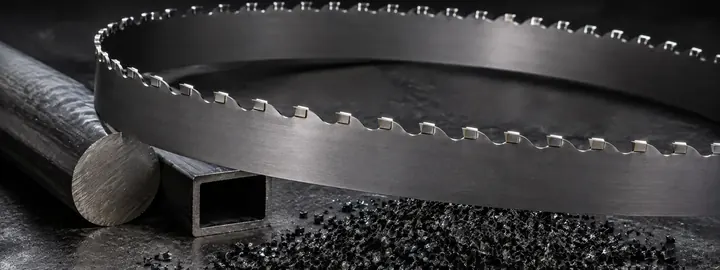
A carbide band saw blade is a blade whose teeth carry a welded tungsten carbide tip. Carbide is much harder than the high-speed steel of a bi-metal blade and keeps its edge even at high temperatures, so it cuts harder materials, at higher speed and with a better finish, and lasts longer.
In exchange, the carbide blade costs more and its tooth is more brittle, so it needs a rigid machine in good condition to perform well. That is why carbide is reserved for the jobs where it really pays off: difficult materials, high production and demanding finishes.
Carbide or bi-metal? When carbide makes sense
Bi-metal is the choice for everyday general cutting, thanks to its cost and versatility. Carbide is the better choice when:
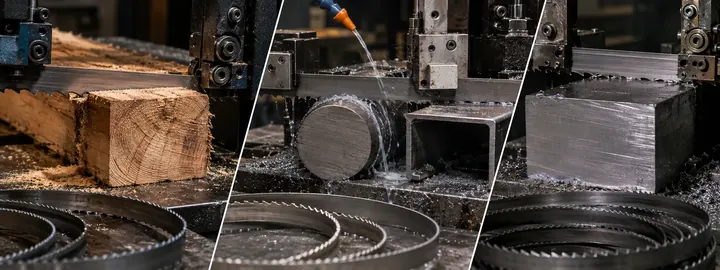
- You cut very hard or abrasive materials: hardened steels, stainless steels, aerospace alloys, cast iron or abrasive non-ferrous metals.
- You have high production volume and need to cut faster to lower the time per part.
- You are looking for a fine, precision finish and have a rigid machine that can take advantage of carbide.
If your material is common and your machine is light, in many cases a bi-metal blade is the better choice. We explain the difference in our article on bi-metal band saw blades.
What is a carbide blade for?
These are the advantages of carbide over high-speed steel:
| Advantage | What does it mean? |
|---|---|
| Cuts very hard materials | Carbide withstands what high-speed steel can't: hardened steels, stainless steels and difficult alloys |
| Higher cutting speed | Cuts faster, which reduces time per part in production |
| Better finish | Leaves a cleaner, more precise surface |
| Longer blade life | The carbide tip keeps its edge much longer |
Tooth geometry: triple chip and multi-chip
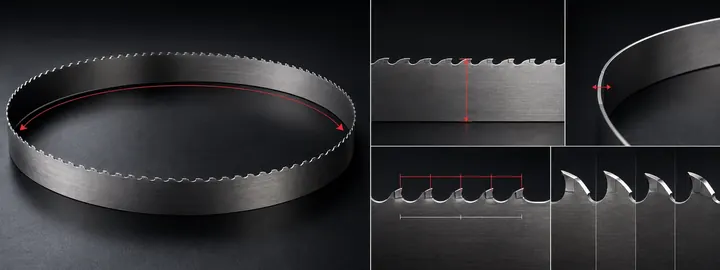
On a carbide blade, the teeth work in groups that form the chips. In triple-chip geometry, a group of teeth forms three chips. Starrett went further with its Multi-Chip (MC) technology: it splits the cut into five or seven chips, distributing the load across more teeth, extending blade life and improving the finish.
Tooth rake angle matters too: a positive rake angle cuts more aggressively and faster, ideal for normal and abrasive materials; a negative rake angle is tougher and is used on hardened materials.
The carbide blades we carry: Starrett Advanz
We carry Starrett's Advanz line, the carbide band saw blade range from one of the most prestigious brands in the world of cutting. Each model is designed for a type of material and level of demand:
| Advanz model | Geometry | For what material? |
|---|---|---|
| Advanz™ TS | Triple chip, aggressive angle | General purpose, ferrous and nonferrous; suitable for less rigid machines |
| Advanz™ MC7 | 7 chips, submicron carbide, positive rake | Difficult steels; maximum productivity and finish |
| Advanz™ MC5 | 5 chips (high/low sequence), positive rake | Alloy steels and aerospace materials; longer blade life |
| Advanz™ CS | Triple chip, negative angle | Hardened materials (carburized up to 60 HRC) |
| Advanz™ FS | Triple chip, positive angle | Abrasive materials: non-ferrous and composites |
How to choose the right carbide band saw blade?
The choice is defined, above all, by the material you are going to cut:
- For general purpose use on ferrous and non-ferrous metals, the Advanz TS.
- For difficult steels and maximum productivity, the Advanz MC7; for alloys and aerospace parts, the Advanz MC5.
- For hardened materials (up to 60 HRC), the Advanz CS (negative rake).
- For abrasive materials, non-ferrous metals and composites, the Advanz FS.
The carbide blade performs best on rigid, stable machines. Because the tooth is harder but also more brittle than a bi-metal tooth, it needs equipment in good condition to avoid chipping. If you are unsure, we review your machine and material and tell you whether carbide or bi-metal suits you better.
In summary
- The carbide band saw blade has teeth tipped with tungsten carbide, much harder than high-speed steel
- Cuts very hard or abrasive materials at higher speed, with a better finish and longer life
- Costs more and needs a rigid machine; for general cutting, bi-metal is usually the better choice
- We carry Starrett's Advanz line: TS, MC7, MC5, CS and FS, each for a type of material
Why buy your band saw blades at NAT MAC?
We have more than 54 years of experience in the industry and ISO 9001 certified quality. We carry Starrett Advanz carbide blades and also our own NATCUT bi-metal line, so we offer the right option for every job and help you choose the right blade for your machine and your material.
- Starrett Advanz carbide band saw blades (TS, MC7, MC5, CS and FS)
- Also our own NATCUT bi-metal line for general cutting
- Advice on choosing between carbide and bi-metal for your material and machine
- Blades welded to the length of your machine
- Backed by ISO 9001 certified quality
Tell us what material you cut, on what machine and in what dimensions, and we will recommend the right band saw blade. Request your free quote.
Sources: NAT MAC Band saw blades catalog (NATCUT and Starrett); Starrett, Band Saw Blades; Starrett, Band Saw Blades Catalog 60.